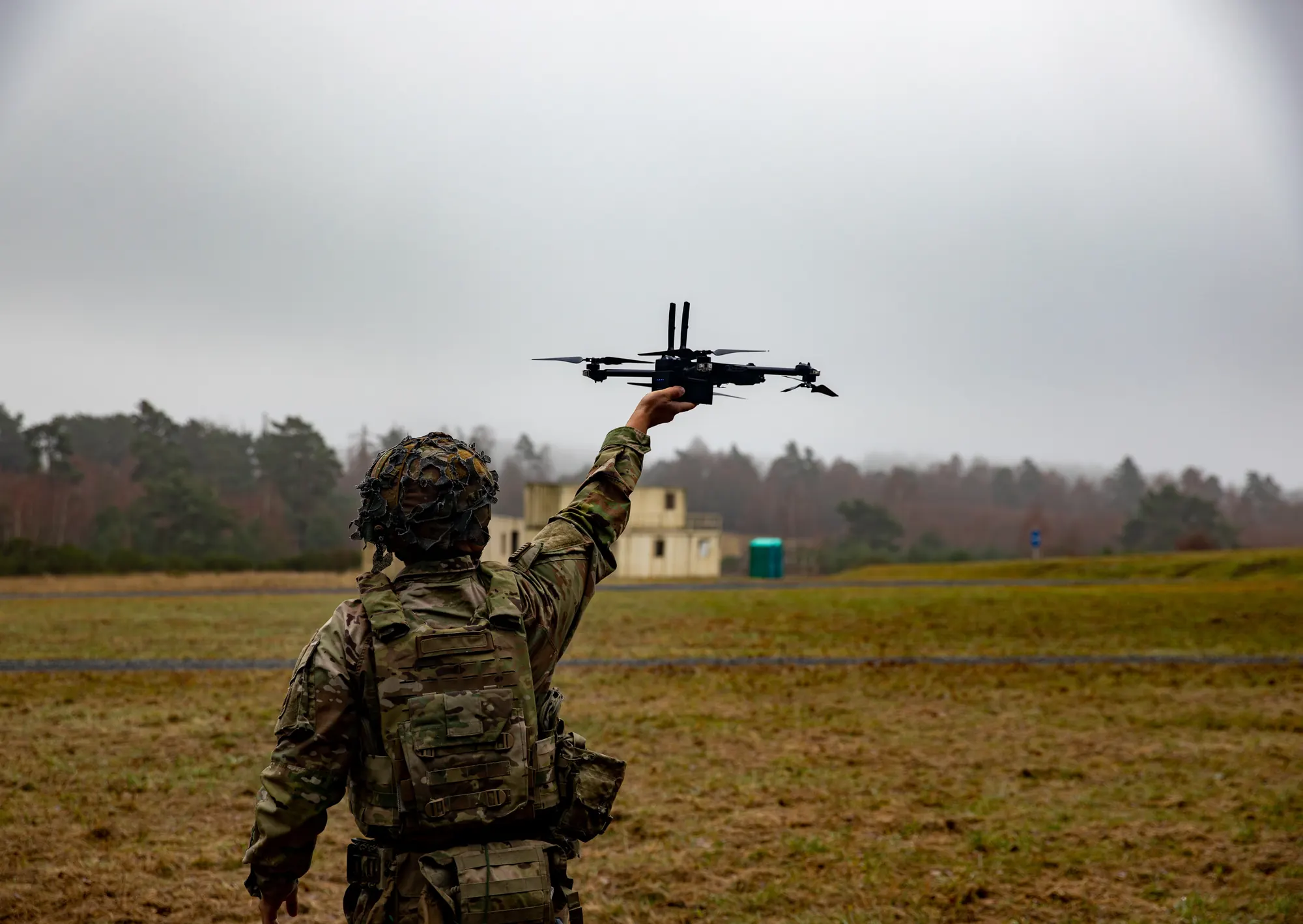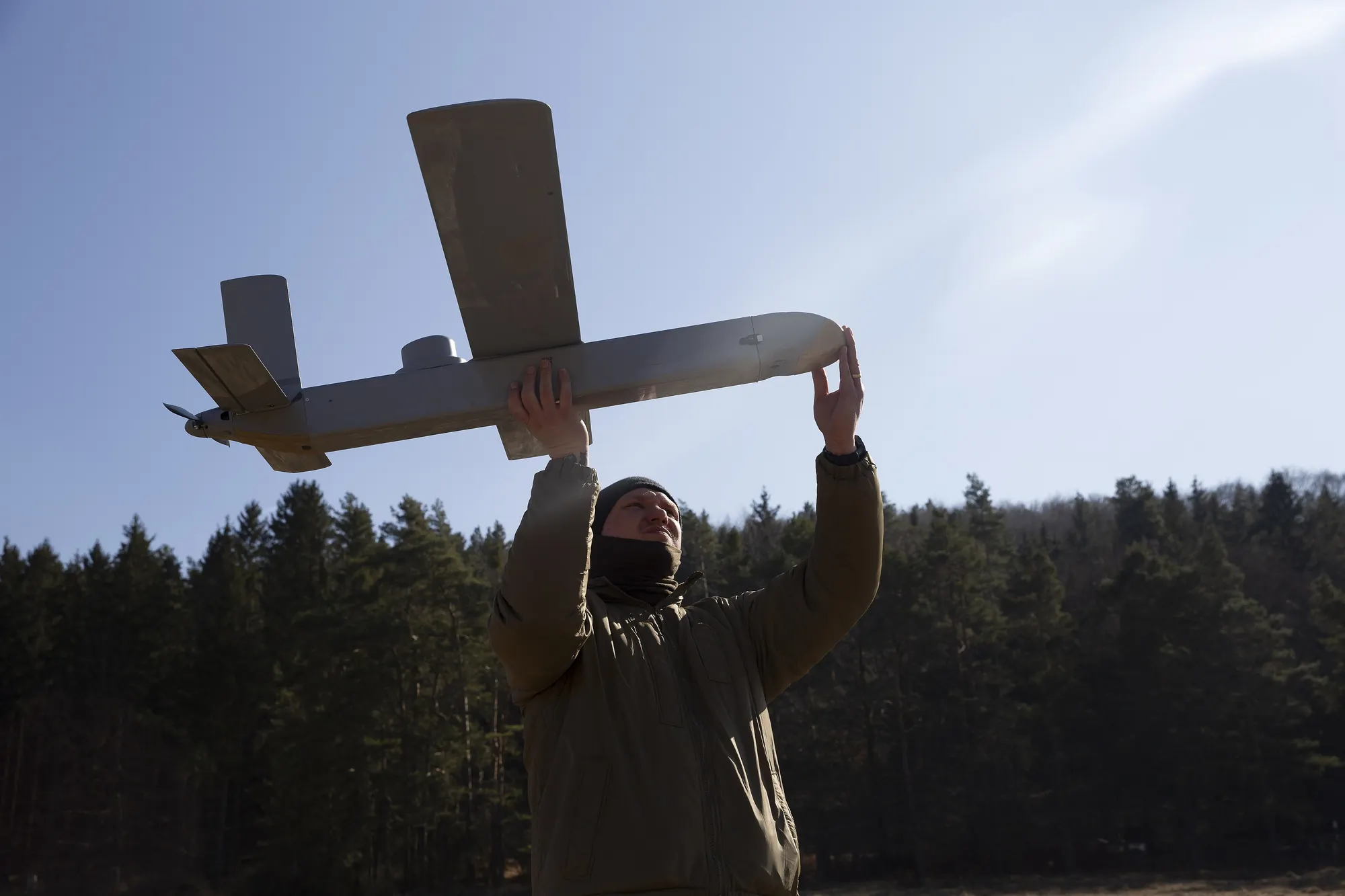
Germany's defence tech (or defense tech) startups are led by three Munich and Berlin companies that are now among the most valuable in Europe: Helsing, valued at $18bn after a $1.8bn Series E on 13 July 2026, Quantum Systems, valued at about $8bn after a $1.2bn Series D on 2 July 2026, and STARK, which raised €500m in June 2026. Behind them sits a fast-growing second tier, from ground robots (ARX Robotics) to interceptor drones (TYTAN Technologies) and launch vehicles (Isar Aerospace). German defence, security and resilience startups raised $2.1bn of venture capital in 2025, according to Dealroom and the NATO Innovation Fund.
This list covers the German companies in our German startup directory, with city, sector, founding year, total funding and latest round as of 22 October 2026. It then explains the three forces behind the boom: a new procurement law, a record defence budget and the Munich cluster.
German defence tech startups at a glance
| Company | City | Sector | Founded | Total funding (approx.) | Latest round |
|---|---|---|---|---|---|
| Helsing | Munich | Defence AI, strike drones | 2021 | $3.3bn | Series E, $1.8bn at $18bn, Jul 2026 |
| Quantum Systems | Gilching (Munich) | Reconnaissance drones | 2015 | $1.6bn | Series D, $1.2bn at about $8bn, Jul 2026 |
| STARK | Berlin | Loitering munitions | 2024 | Over €660m | Series C, €500m at €3.2bn to over €3.5bn, Jun 2026 |
| Isar Aerospace | Ottobrunn (Munich) | Space launch | 2018 | About €870m | Series D, €270m, Jun 2026 |
| HyImpulse | Neuenstadt am Kocher | Rockets, hypersonic testing | 2018 | About €95m | Series A extension, over €50m, Sep 2026 |
| Reflex Aerospace | Berlin | Satellites | 2021 | About €57m | Series A, €50m, Nov 2025 |
| TYTAN Technologies | Munich | Interceptor drones | 2023 | €46m | Series A, €30m, Feb 2026 |
| ARX Robotics | Munich | Ground robots | 2022 | €42m | Series A extension, €11m, Jul 2025 |
| ATMOS Space Cargo | Lichtenau | Return capsules | n/d | n/d | Series A, €25.7m, Apr 2026 |
| Hypersonica | Wessling (Munich area) | Hypersonic strike | 2023 | About $26m | Series A, €23m, Feb 2026 |
| Project Q | Munich | Command and control software | 2024 | About €22.5m | Series A, €15m, Jul 2026 |
| INLEAP Photonics | Hanover | Laser counter-drone | 2023 | About €20m | Seed, about €20m, Sep 2026 |
| Marble Imaging | Bremen | Earth observation | 2023 | About €15m | Seed, €5.3m, Dec 2025 |
| Vyoma | Munich | Space surveillance | 2020 | About $14.7m | Seed, €5m, Apr 2024 |
| POLARIS Raumflugzeuge | Bremen | Hypersonic spaceplanes | 2019 | About €12.4m | Seed top-up, €5.4m, Jun 2025 |
| Twentyfour Industries | Munich | Mass-produced drones | 2024 | $11.8m | $11.8m, Jan 2026 |
| Alpine Eagle | Munich | Airborne counter-drone | 2023 | About €10.25m | Seed, €10.25m, Mar 2025 |
| Swarm Biotactics | Kassel | Bio-robotic swarms | n/d | About €10m | Seed, €10m, Jun 2025 |
| Ground A | Düsseldorf | Laser counter-drone | 2026 | About €9.1m | Pre-seed, about €9.1m, Sep 2026 |
| DeltaOrbit | Garching | Space | 2023 | About €5m (non-dilutive) | n/d |
Totals are approximate sums of announced rounds from our directory and from Dealroom's European defence list (updated 22 October 2026); most companies do not publish a cumulative figure. "n/d" means not disclosed.
The big three: Helsing, Quantum Systems and STARK
Helsing, founded in Munich in 2021, started as a defence AI software company and now also builds the HX-2 strike drone. Its $1.8bn Series E at an $18bn valuation was described by Defense News as Europe's biggest-ever funding round for a defence technology startup. The full round-by-round history is in our Helsing valuation guide.
Quantum Systems, based in Gilching near Munich, makes the Vector, Twister and Reliant reconnaissance drones. Its Series D was co-led by Blackstone, Noteus, Airbus and Advent, and more than doubled the "over €3 billion" valuation set in November 2025, Tech.eu reported. Co-founder Florian Seibel said the company is profitable. See our Quantum Systems valuation and IPO analysis.
STARK, founded in Berlin in 2024, builds the Virtus loitering munition. Sequoia Capital and Founders Fund co-led its €500m Series C, with the NATO Innovation Fund, Project A and Air Street Capital also investing, The Next Web reported. The valuation is reported as €3.2bn by Bloomberg and above €3.5bn by other outlets; our STARK funding analysis explains the gap. In February 2026 Germany awarded STARK and Helsing initial loitering munition contracts of roughly €269m each, with frameworks that could reach €1bn per company, according to the same report.
The second tier: robots, interceptors and software
ARX Robotics, in Munich, builds the Gereon family of uncrewed ground vehicles and Mithra OS, software that adds autonomy to existing military vehicles. It raised a €31m Series A led by HV Capital in April 2025 and an €11m extension led by Speedinvest in July 2025, taking total funding to €42m, per Vestbee. We found no newer round as of October 2026.
TYTAN Technologies makes METIS, an AI-guided interceptor drone. Its €30m Series A was co-led by Armira and the NATO Innovation Fund, bringing total funding to €46m, Munich Startup reported on 27 February 2026. Ukraine has procurement agreements for thousands of METIS interceptors, and the German procurement office BAAINBw works with TYTAN on command and control for protecting military sites.
Project Q builds Hydris, an open platform that links sensors, drones and command systems. Expeditions led its €15m Series A in July 2026, with listed sensor maker Hensoldt joining as a strategic investor, according to Munich Startup. Twentyfour Industries emerged from stealth in January 2026 with $11.8m from Lakestar, OTB Ventures and 468 Capital for a "mass-manufacturable" 10-inch quadcopter, Tech.eu reported.
In counter-drone, Alpine Eagle's Sentinel uses a mothership drone carrying smaller interceptors, with the Bundeswehr as launch customer. Hanover's INLEAP Photonics, a Laser Zentrum Hannover spin-off, raised about €20m in September 2026 led by UVC Partners for laser-based drone defence, per UVC Partners. For the full picture see our guide to counter-drone companies in Europe.
Space and hypersonics
Germany also has Europe's densest cluster of new launch and space companies, many of which sell to defence buyers. Isar Aerospace closed a €270m Series D in June 2026 with new investors Island Green Capital and Molten Ventures, and is building a factory in Parsdorf near Munich designed for up to 40 Spectrum rockets a year, Munich Startup reported. A law firm that advised investors, Greenberg Traurig, put the valuation at more than €2bn; Isar itself did not publish one.
HyImpulse raised more than €50m in a Series A extension co-led by JOIN Capital and Ace Capital Partners in September 2026; its SR75 rocket is built for "research, testing and defence applications", Tech.eu reported. Hypersonica, founded in December 2023, raised €23m in a Series A led by Plural with Germany's breakthrough innovation agency SPRIND, and aims to deliver a European hypersonic strike capability by 2029, Defense News reported.
Procurement reform: the 2026 acceleration law
For years German startups complained that the Bundeswehr bought slowly and mostly from incumbents. On 15 January 2026 the Bundestag passed the Bundeswehr planning and procurement acceleration law (BwPBBG), which replaces the 2022 version, the Defence Ministry said. It entered into force on 14 February 2026 and runs until the end of 2035, law firm Heuking noted.
Three provisions matter most for young companies:
- Advance payments: contracting authorities may pay in advance to attract more bidders, which the ministry says opens contracts to startups and less capital-rich firms.
- Fewer tenders: thresholds for direct awards below EU limits rise, and the obligation to split contracts into lots is suspended.
- Faster disputes: a challenge before the regional appeal court no longer automatically freezes the award.
The need was real. In a Bitkom survey reported by Börsen-Zeitung on 13 February 2026, only about one in five German defence tech startups said they had received a direct Bundeswehr order through BAAINBw, and a further 8% had won orders under Ukraine aid. The share of founders who would start their company in Germany again rose to 49% from 39% a year earlier.
The money: a record defence budget
Demand is backed by spending. For 2026, Germany's core defence budget is €82.69bn plus €25.51bn from the Bundeswehr special fund, and the 2027 draft adds about €31.4bn, taking the total to just under €140bn if the Bundestag approves it in November, according to the Defence Ministry (9 September 2026). Only a small share of that goes to startups, but loitering munition and drone orders show the share is growing.
Why Munich: the cluster
Most of the companies above sit within an hour of Munich. The number of pure defence startups around the city has roughly doubled to about 60 in recent years, according to the local Chamber of Commerce and Industry, cited by AFP via The Local on 1 September 2026. The Dealroom and NIF report also names Munich as Europe's leading defence, security and resilience hub.
The reasons are structural: a long aerospace history (Airbus Defence and Space and Hensoldt are nearby), the Technical University of Munich, where TYTAN's founders studied, and a Bavarian government that industry describes as supportive. Problems remain: founders cite long security vetting for staff and slow permits for warehouses and production sites. Berlin (STARK, Reflex Aerospace) and Bremen (POLARIS, Marble Imaging) are the other centres.
Who invests in German defence tech
The investor base has changed fast. Early rounds were led by European venture firms and family offices: General Catalyst, Lakestar, HV Capital, Project A, Plural, Visionaries Club and Expeditions appear repeatedly, alongside public money from HTGF, KfW Capital, Bayern Kapital and SPRIND. The NATO Innovation Fund has backed STARK and TYTAN. Strategic investors include Airbus (Quantum Systems) and Hensoldt (Project Q, Quantum Systems).
The 2026 mega-rounds brought in US and global late-stage capital: Dragoneer and Lightspeed in Helsing, Sequoia and Founders Fund in STARK, Blackstone, Fidelity and Advent in Quantum Systems. Browse the full directory or the NATO Innovation Fund portfolio for more.
What to watch
Three questions will decide the next year. Can STARK, Helsing and TYTAN show production at the volumes ministries want? Will the new procurement law translate into more direct orders for smaller firms, beyond the headline loitering munition contracts? And will Quantum Systems or Helsing test public markets? None of the companies in this article is listed; they are private and have no stock ticker.
This article is for information only and is not investment advice.