Quantum Systems, the Munich-area maker of military reconnaissance drones, was valued at about $8 billion (roughly €7 billion) post-money when it announced a $1.2 billion Series D on 2 July 2026, according to Tech.eu and Dealroom. That more than doubled the "over €3 billion" mark set in November 2025. The company is private, has no ticker, and has not filed for an IPO as of 22 October 2026.
This is the German defence company behind the Vector, Twister and Reliant drones, not a quantum computing firm. Below: every disclosed funding round, the products that drive revenue, its production in and with Ukraine, and what has actually been reported about a listing. For the company profile, see Quantum Systems in our directory.
Quantum Systems valuation: the July 2026 Series D
The Series D was co-led by Blackstone, Noteus, Airbus and Advent, with Bond, Fidelity and Elephant Lake Ventures also taking part, per Tech.eu. The Next Web adds Wellington Management, A.P. Moller Holding and returning backers Balderton and HV Capital.
Two details matter when reading the headline number. First, the euro conversion varies: Dealroom put the round at €1 billion, while the German trade site ESUT converted it to about €1.1 billion. Both agree on a valuation of about €7 billion. Second, Dealroom reported that a small, undisclosed part of the round was secondary, meaning some existing shareholders sold rather than all of the money going to the company.
The company said the money will fund international expansion, more manufacturing capacity, AI software and acquisitions. Dealroom reported target markets including Romania, the UK, the Middle East and Asia Pacific.
Quantum Systems funding: every disclosed round
Quantum Systems was founded in 2015 by Florian Seibel, a former Bundeswehr helicopter pilot who is co-CEO alongside Sven Kruck. Its rounds have grown sharply since Russia's full-scale invasion of Ukraine in 2022.
| Date | Round | Amount | Lead or key investors | Reported valuation |
|---|---|---|---|---|
| Oct 2023 | Series B (first close) | €63.6M | Not named in the source we used | Not disclosed |
| Sep 2024 | Series B extension | Total over €100M | Notion Capital, Porsche SE | Not disclosed |
| 6 May 2025 | Series C | €160M | Balderton Capital (lead); Hensoldt, Airbus Defence and Space, Bullhound, LP&E | Not disclosed |
| 28 Nov 2025 | Series C extension | €180M | Balderton Capital (lead) | Over €3B |
| 2 Jul 2026 | Series D | $1.2B (about €1B to €1.1B) | Blackstone, Noteus, Airbus, Advent (co-leads) | About $8B post-money |
Sources: Tech.eu (Series B), Omnes Capital (Series C), Tech.eu (Series C extension), Tech.eu and Dealroom (Series D).
According to Omnes Capital, an existing investor, the May 2025 round brought total funding to €310 million. With the €180 million extension, 2025 fundraising reached €340 million, which Tech.eu described at the time as the largest private raise in Europe's dual-use sector. The company has not published a cumulative figure since the Series D. Adding the disclosed rounds gives roughly €1.5 billion, but that is our arithmetic, and the secondary portion of the Series D did not reach the company.
The prior valuation is also reported in two ways. Tech.eu and The Next Web describe the November 2025 mark as "over €3 billion" or about €3 billion. Some outlets converted it to about $3.5 billion. Either way, the Series D more than doubled it in about seven months.
Revenue and profitability
Quantum Systems does not publish audited accounts in the way a listed company would, so revenue figures come from management statements reported in the press. Dealroom and The Next Web both reported that revenue roughly doubled to about €300 million in 2025, with similar growth expected in 2026.
Seibel said in the Series D statement that the company is "profitable, deployed around the world". The Next Web reported double-digit margins, per the company. The smaller outlet Großwald reportedly put the 2026 revenue target near €700 million and headcount at about 1,600; we could not confirm those two figures in a second source. In November 2025, Tech.eu reported up to 1,000 employees.
On those numbers, the $8 billion valuation is a little over 20 times 2025 revenue, or about 10 times the reported 2026 target if it is met. That multiple is our own calculation, not a figure from the company or investors.
Products: Vector, Twister, Reliant and beyond
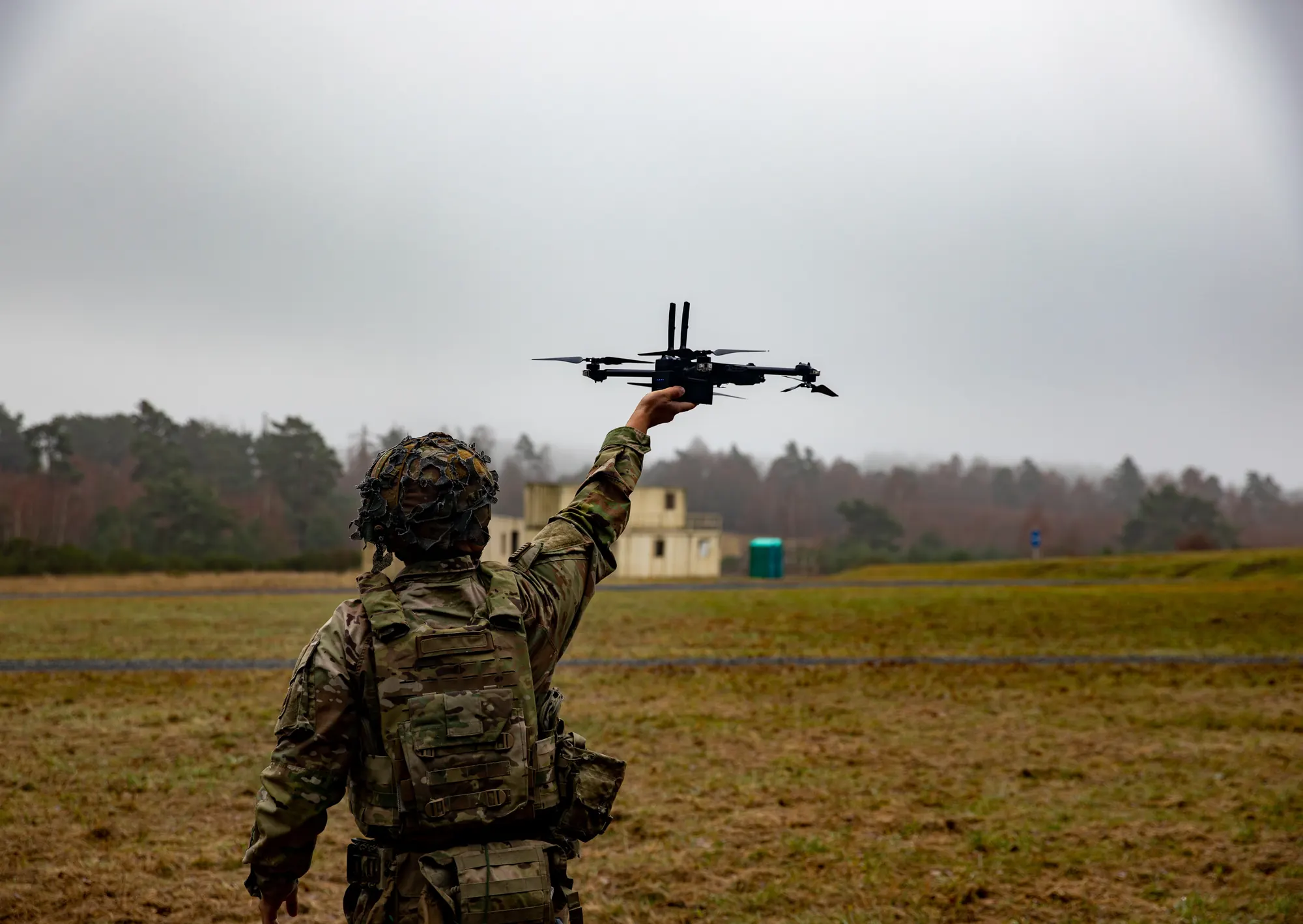
The core business is electric vertical take-off and landing (eVTOL) drones for reconnaissance. In a 27 July 2026 release, the company described its air family as three tiers:
- Twister (short range): a rucksack-portable eVTOL drone with a 4 kg maximum take-off weight, 90-minute endurance and 15 km range, per Defence Industry Europe.
- Vector AI (mid range): the platform launched in 2019 and combat-tested in Ukraine, according to Omnes Capital. The German Falke system builds on it.
- Reliant (long range): a hybrid-electric VTOL drone carrying up to 9 kg of payload such as electro-optical sensors, synthetic aperture radar, SIGINT or electronic warfare kits.
All of these run on the company's MOSAIC UXS mission software. Through acquisitions, Quantum Systems has also moved beyond the air domain. Tech.eu lists AirRobot, Nordic Unmanned and Spleenlab, and Munich Startup reported the purchase of Fernride, a ground autonomy software company, on 19 December 2025, terms undisclosed.
Quantum Systems has historically built reconnaissance drones rather than strike drones aimed at ground targets. The Next Web reported that weapons restrictions held by some investors were the reason Seibel set up the strike drone maker STARK as a separate company in 2024. Großwald, citing the Financial Times, reported that the Series D let investors uneasy with lethal systems exit, clearing the way for armed products. Our analysis of STARK's funding and valuation covers the sister company.
German contracts
Two German orders in December 2025 underpin the revenue outlook. On 12 December 2025, DroneXL, citing documents reviewed by Bloomberg, reported a contract worth about €210 million for 520 Falke surveillance systems for delivery in 2026, with options for up to 500 more between 2027 and 2032. DroneXL said that order equalled about 75% of projected 2025 revenue.
Separately, the Bundeswehr procurement agency signed a framework for Twister as the successor to the ALADIN reconnaissance drone. It includes a fixed order of 147 systems and options for up to 600 more, with Quantum Systems committing to at least 250 systems a year, per Defence Industry Europe on 13 December 2025. The 747 total is a ceiling, not a guaranteed purchase.
Ukraine production and joint ventures
Quantum Systems drones have flown in Ukraine since 2022. The company said its systems completed more than 19,000 missions there in 2025, per The Next Web.
- Own factory: it opened a drone plant in Ukraine on 18 April 2024, investing about €6 million over two years and targeting capacity of 1,000 drones a year, per Euromaidan Press.
- Dispersed sites: Politico reported in 2025, as summarised by Online.ua, that the company builds about 80 Vector drones a month across several Ukrainian regions, against about 120 a month in Germany.
- Joint ventures: under the "Build with Ukraine" initiative it formed Quantum Frontline Industries (with Frontline Robotics), Quantum WIY Industries (interceptor drones, with WIY Drones) and Quantum Tencore Industries (ground vehicles, with Tencore), per European Security & Defence. The same report says Ukraine tasked Quantum Systems with delivering 15,000 Strila interceptor drones.
Much of the joint venture output is made in Germany. On 6 October 2026, European Security & Defence reported a 2027 follow-on contract from Ukraine's National Guard for Linza and Zoom drones built by Quantum Frontline Industries, with a planned fivefold capacity increase for 2027. In June 2026, the Tencore venture won a German-funded order for 2,000 TerMIT ground vehicles for Ukraine, also to be built in Germany.
Quantum Systems IPO: what has been reported
There is no confirmed IPO date, exchange or share price. Quantum Systems stock cannot be bought on a public market; shares change hands only in private rounds and secondary sales between investors.
The reporting so far, in order:
- 19 February 2026: Manager Magazin, citing unnamed sources and carried by Reuters, reported that the company was preparing an IPO that could happen by early 2027, and had mandated Morgan Stanley for a €400 million to €600 million round. A spokesperson declined to comment.
- 2 July 2026: with the Series D, the company said it had completed an IPO readiness assessment but was in no rush to list, according to Dealroom and The Next Web.
- July 2026: Großwald reportedly described a supervisory board mandate to become IPO-ready, naming the first half of 2027 as the earliest window. This is single-source.
The Series D itself raised more than the €400 million to €600 million first reported in February, which reduces near-term pressure to list. A merger with STARK has also been floated: Seibel said "If it makes sense, we'll do it", as reported by Bloomberg via The Next Web, while telling the FT there was "no roadmap". A STARK spokesperson said there are no plans to merge.
How it compares
At about $8 billion, Quantum Systems is among the most valuable private defence companies in Europe, alongside Helsing. STARK was valued at between €3.2 billion and more than €3.5 billion in June 2026, depending on the source. For more companies in the segment, browse the drones sector and German defence startups in our directory.
This article is for information only and is not investment advice. Valuations of private companies are set in negotiated rounds and can differ from what a public market would pay.