STARK Defence, the Berlin maker of the Virtus loitering munition, raised €500 million in a Series C announced on 23 June 2026, co-led by Sequoia Capital and Founders Fund. Its valuation is reported two ways: €3.2 billion according to Bloomberg, as carried by The Star, and more than €3.5 billion according to The Next Web and other outlets. STARK is private and has no ticker.
This article is about the German defence company (legal name SKD SE, trading as STARK), not the common English word or other firms with similar names. It covers the funding rounds, why the valuation figures differ, the Bundeswehr order for Virtus, and the trial reports that shadowed that order. The company profile is in our directory under STARK.
STARK Defence valuation: €3.2 billion or €3.5 billion?
The round size is not in dispute. The valuation is. Here is what each source says:
- €3.2 billion: The Star, publishing Bloomberg's report on 25 June 2026, wrote that the financing gives STARK a valuation of €3.2 billion and attributed that figure to a company statement issued on Tuesday 23 June.
- More than €3.5 billion: The Next Web reported a valuation above €3.5 billion, about triple the €1 billion mark it crossed earlier in 2026. Großwald, citing Handelsblatt among others, also gave "more than €3.5 billion".
- €3.5 billion "per the company": Tectonic attributed the €3.5 billion figure to STARK itself.
So both figures have been attributed to the company by different outlets. One plausible explanation, which no source has confirmed, is the difference between pre-money and post-money valuation: €3.2 billion before the round plus €500 million of new capital gives about €3.7 billion after it. We could not find the original statement on STARK's website, so the safe description is a valuation between €3.2 billion and more than €3.5 billion.
STARK funding rounds since 2024
STARK was founded in Berlin in 2024. Wikipedia lists Johannes Schaback, Florian Seibel and Uwe Horstmann as founders. Seibel also co-founded the reconnaissance drone maker Quantum Systems and has since stepped back to a founding investor role. Horstmann, a founding partner of Project A, became CEO in October 2025.
| Date | Round | Amount | Lead or key investors | Reported valuation |
|---|---|---|---|---|
| Aug 2025 | Series B (per The Next Web) | About $62M | Sequoia Capital | About $500M |
| Early 2026 | Undisclosed round | Not disclosed | Not disclosed | Above €1B (reported by Reuters, per Tectonic) |
| 23 Jun 2026 | Series C | €500M | Sequoia Capital, Founders Fund (co-leads); NATO Innovation Fund, Project A, Air Street Capital, 201 Ventures, Döpfner Capital, Advent | €3.2B (Bloomberg) or above €3.5B (other outlets) |
Total funding is also reported inconsistently. The Next Web put it at more than €660 million, up from about €160 million before the Series C. Großwald gave about €640 million. Bloomberg, via The Star, said STARK had raised €140 million in total before this round, which would point to about €640 million afterwards.
On use of funds, STARK said more than 80% of the new capital goes to research and manufacturing, including electronic warfare research facilities and scaling to "thousands of systems per month", per Tectonic. Horstmann said: "The challenge facing Europe is no longer whether we can innovate, it's whether we can scale."
Ownership and Peter Thiel
Peter Thiel's involvement drew political scrutiny in Germany. A defence ministry briefing told lawmakers that Thiel Capital owned less than 10% of STARK, and a STARK representative said Thiel's overall stake, including his Founders Fund holding, fell after the Series C, per The Star. Defence Minister Boris Pistorius said on 25 February 2026 that the stake was a single-digit percentage with no access to operations, according to Defense News. The Next Web reported that founders and employees hold the majority after the round, with the rest spread across about 50 investors.
The Virtus loitering munition and other products
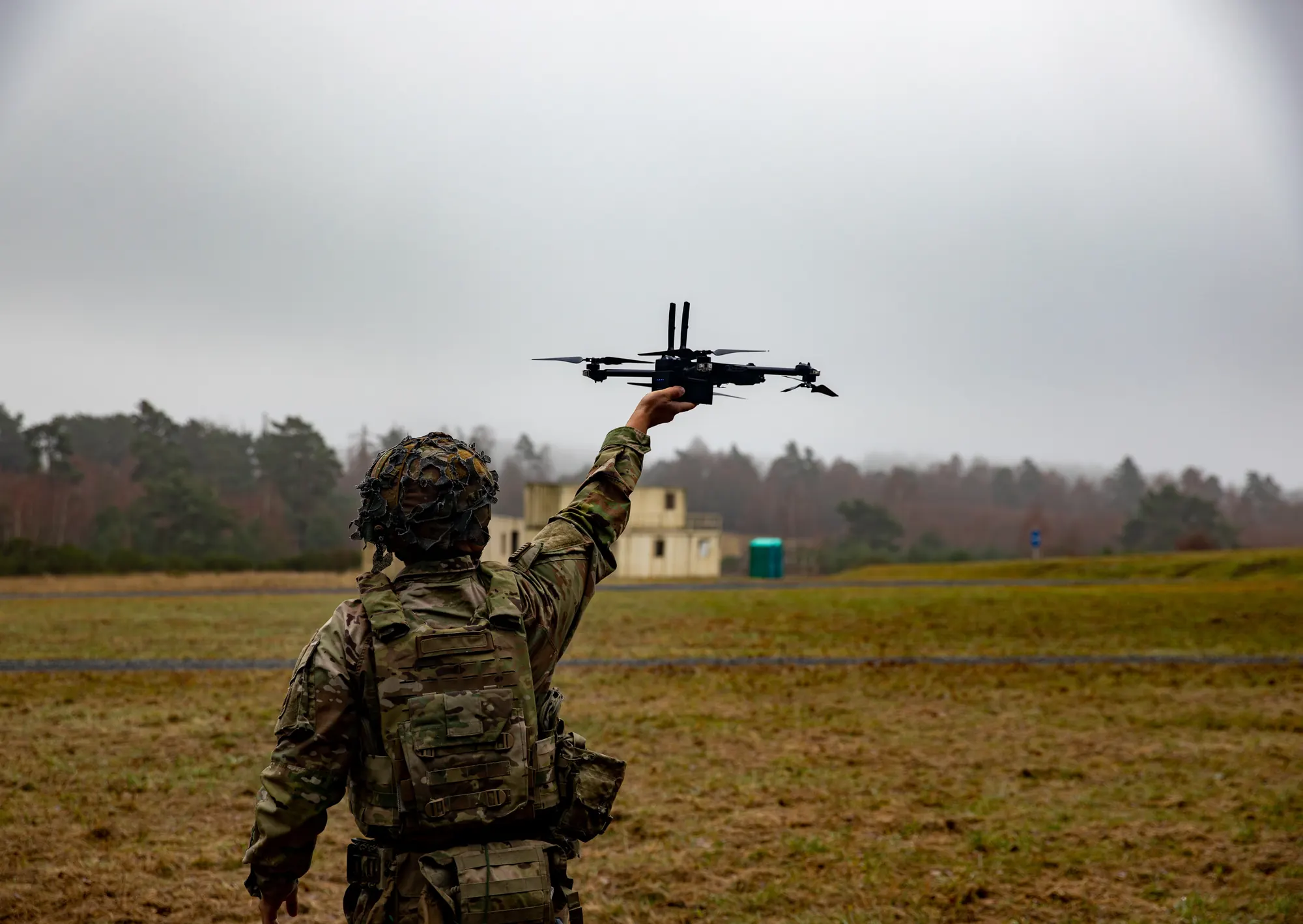
Virtus is an electric loitering munition that takes off and lands vertically (VTOL), so unused units can be recovered and reused in training. In its 26 February 2026 release, STARK gave a range of over 130 km, endurance of up to 90 minutes and a German warhead system. Earlier press coverage in October 2025 cited a range of up to 100 km and a 5 kg warhead, so published figures have changed over time.
The wider portfolio, according to the company website and its press releases:
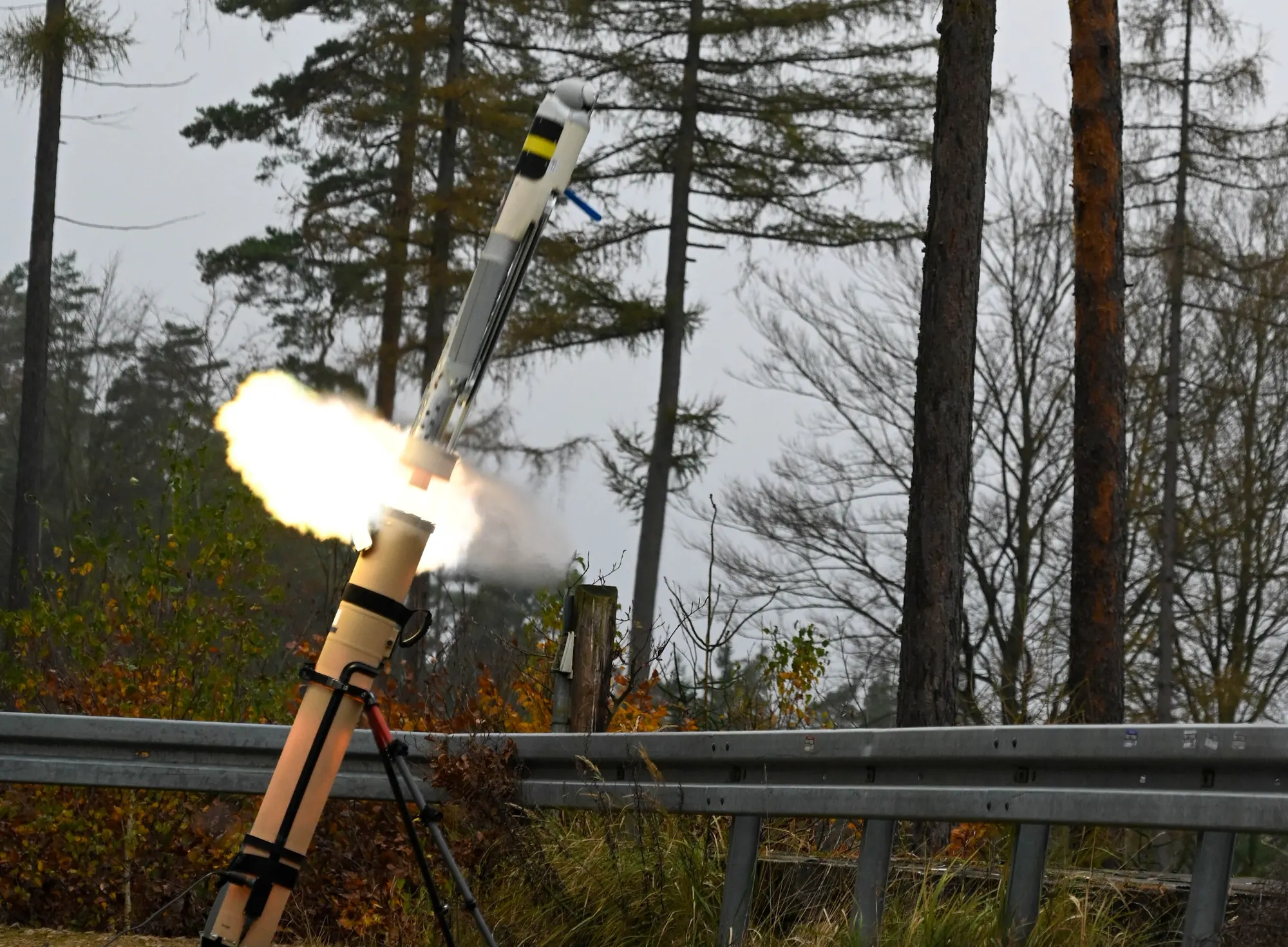
- Cascade: a tube-launched short-range loitering munition unveiled on 8 June 2026. DroneXL reported ranges of 40, 60 or 100 km depending on battery.
- Gambit: a foldable quadcopter in strike and reconnaissance variants. STARK reported a warhead impact demonstration with TDW on 26 August 2026.
- Vanta 6 and Vanta 12: uncrewed surface vessels for maritime ISR and strike.
- Minerva: command and control software for recce-strike missions and swarms.
- Electronic warfare: the R-Zero system, expanded by the acquisition of Raydiant RF, announced on 4 September 2026.
STARK says it operates in Germany, Ukraine, the United Kingdom, Sweden and Greece, with 18,500 square metres of production space. The Next Web reported a 40,000 sq ft factory in Swindon, England, opened in 2025.
The Bundeswehr order for Virtus
The German order came in stages, and the numbers in circulation refer to different things.
- Late October 2025: the Financial Times reported plans to buy about 12,000 loitering munitions for roughly €900 million, about €300 million each from Helsing, STARK and Rheinmetall, as summarised by PC-WELT. Pistorius then said, per the Augengeradeaus blog, that no decision had been taken and testing would run to the end of 2025.
- 10 to 12 February 2026: procurement documents obtained by the FT showed initial contracts of €269 million each for STARK and Helsing, with options that could take STARK to €2.86 billion and Helsing to €1.46 billion, per Resilience Media. Drone quantities were redacted. Rheinmetall was left out of this first award.
- 25 February 2026: the Bundestag budget committee approved the two initial contracts, each worth €268 million according to Defense News (about €269 million in other reports). Options can add up to €1 billion per supplier, but only if the systems prove mature and lawmakers approve further purchases. DroneXL, citing Reuters, reported that the combined long-term ceiling was cut from €4.3 billion to €2 billion.
- 26 February 2026: STARK signed the framework agreement for "several thousand" Virtus systems for Brigade 45 in Lithuania, with deliveries starting in 2026 and full delivery within two years of successful qualification.
So the "€2.8 billion framework" figure seen in some coverage is the option ceiling in the draft documents, not an approved amount. The firm commitment is about €268 million to €269 million, and Defense News reported cancellation clauses that let the government drop any system that fails qualification tests. Fielding with the Lithuania brigade is planned for 2027.
The Virtus trial controversy
The order was politically sensitive because of reported test failures. In late October 2025, the Financial Times reported that Virtus failed to hit a target in four strike attempts during trials with British and German forces, as relayed by DroneXL. Later FT reporting, cited by Resilience Media, described the failures as occurring in two separate tests.
Specific incidents reported by PC-WELT, citing the FT: in a test at Munster in late October 2025, one drone lost control and crashed into a forest, and in a British Army test in Kenya another drone's battery reportedly ignited after impact. In the same trials, Helsing's HX-2 reportedly completed its tests. The Rheinmetall system did not take part.
STARK called the setbacks "an integral part of trialling and developing new technology", according to the FT as quoted by Resilience Media. Wikipedia, citing the FT, records the company saying it had crashed drones "a hundred times" during development.
The picture changed in December 2025. General Carsten Breuer, Germany's chief of defence, visited further trials and said both Virtus and HX-2 had over 90% probability of destroying targets in controlled testing, as reported by DroneXL. That figure has not been published in an official test report that we could find.
Two further points complete the record. On 16 February 2026, STARK issued a statement rejecting claims in a video by a Ukrainian military unit, saying the unit had since officially requested more Virtus systems and that "many changes" had been made to Virtus since its trials with that unit. And on 29 April 2026, STARK said Virtus performed reliably in a Bundeswehr recce-strike swarm exercise alongside the Quantum Systems Vector drone. Both are company statements; independent test data has not been published.
What the valuation rests on
STARK has not disclosed revenue. Its valuation therefore rests on contracts, options and expected demand rather than reported sales. The firm Bundeswehr commitment is about €268 million to €269 million, with up to €1 billion more subject to qualification and parliamentary approval. The Next Web noted that STARK "has not yet demonstrated manufacturing at the volumes that defence ministries require".
The company is often compared with Helsing, which competes for the same German order, and with Quantum Systems, valued at about $8 billion in July 2026. See our Quantum Systems valuation and IPO analysis, the loitering munitions sector and German defence startups in the directory. Seibel has floated a merger between Quantum Systems and STARK; a STARK spokesperson said there are no plans to merge, per Tech.eu.
This article is for information only and is not investment advice. STARK is a private company with no public shares, and private valuations are set in negotiated rounds.