European military drone manufacturers fall into two groups: aerospace primes such as Airbus, Leonardo, Thales, Rheinmetall, Schiebel and Poland's WB Group, and venture-backed companies such as Helsing, Quantum Systems, Tekever and STARK. As of October 2026 the newcomers carry the largest private valuations: Helsing raised $1.8bn at an $18bn valuation on 13 July 2026, Quantum Systems $1.2bn at about $8bn on 2 July 2026, and Tekever a $580m first close at $6.4bn on 23 September 2026.
This list covers companies headquartered in Europe that design and build uncrewed aircraft for armed forces. It is organised by mission, because a buyer choosing a long-endurance surveillance aircraft and a buyer choosing a loitering munition are shopping in different markets. For the defensive side of the same story, see our companion piece on counter-drone companies in Europe.
The 2026 list at a glance
| Company | Country | Flagship system | Category |
|---|---|---|---|
| Quantum Systems | Germany | Vector | VTOL tactical ISR |
| Tekever | Portugal | AR5 | Long-endurance ISR |
| Schiebel | Austria | Camcopter S-100 | Rotary VTOL ISR |
| FlyFocus | Poland | Fixed-wing ISR and tethered UAV | Tactical ISR |
| FuVeX | Spain | Long-range BVLOS drones | Dual-use ISR |
| Dronus | Italy | NEST | Autonomous security drones |
| Airbus (with partners) | Germany, France, Italy, Spain | U950 Eurodrone | MALE (in development) |
| LBA Systems (Leonardo and Baykar) | Italy | Astore Levante | MALE |
| Helsing | Germany | HX-2 | Loitering munition |
| STARK | Germany | Virtus | Loitering munition |
| Rheinmetall | Germany | FV-014 | Loitering munition |
| WB Group | Poland | Warmate, FlyEye | Loitering munition and ISR |
| Thales | France | Toutatis | Loitering munition |
| MBDA | France and UK (European group) | Akeron RCH 170 | Loitering munition |
| Orqa | Croatia | MRM2-10 and FPV components | FPV |
| Destinus | Netherlands | Ruta, Kryla (with Rheinmetall) | Long-range strike |
Startups on this list have full profiles in our drones sector directory and the loitering munitions directory.
Tactical ISR and VTOL drones
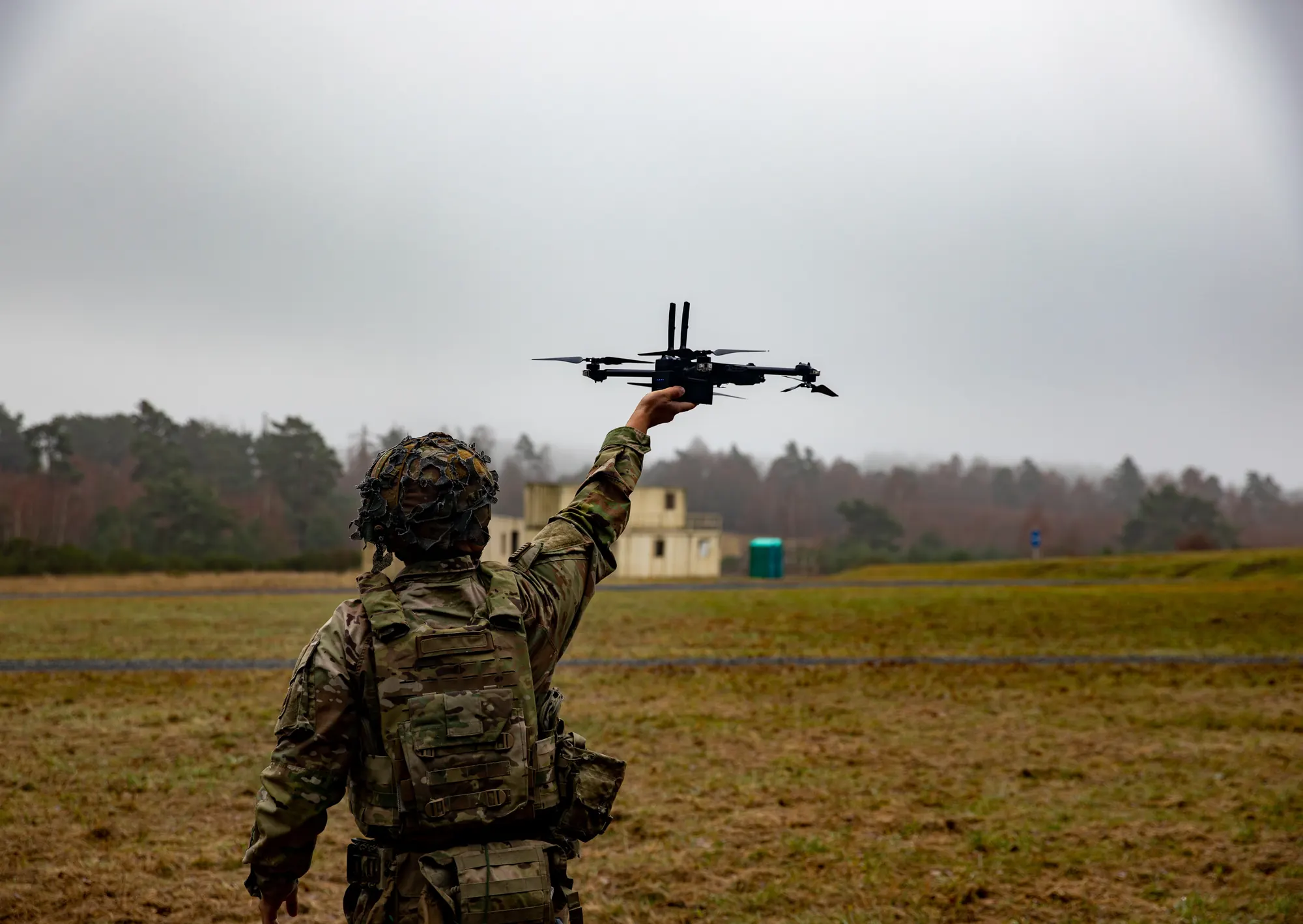
Small and medium reconnaissance drones are the volume end of the market, and the segment where European startups have grown fastest. Quantum Systems, based near Munich, builds the Vector, a vertical take-off and landing reconnaissance aircraft used by Ukrainian forces. Its $1.2bn Series D, announced on 2 July 2026, was co-led by Blackstone, Noteus, Airbus and Advent, according to The Next Web. The company reported about €300m of revenue in 2025, roughly double the prior year, and says it flew more than 19,000 missions in Ukraine in 2025.
Quantum Systems also sells a software layer, MOSAIC UXS, that links its aircraft, sensors and counter-drone tools. It lists production in Germany, Ukraine, the United States, Australia, Romania, the UK and the Baltics, which makes it one of the few European drone makers already manufacturing on several continents.
Austria's Schiebel is the established name in rotary-wing ISR. Its Camcopter S-100 flies from ships as well as land. On 13 February 2026 the Hellenic Navy ordered four S-100 systems for its new FDI frigates, and the first two systems passed acceptance tests in April 2026, EDR Magazine reported.
Further down the funding curve sit specialists. Poland's FlyFocus raised €4.5m in February 2026, its first institutional round after eight years of self-funding, led by ffVC with the NCBR Investment Fund, per Tech.eu. It makes ISR platforms, loitering systems and a tethered UAV, and plans a Polish factory in the second half of 2026. Spain's FuVeX raised €3m in August 2026 for long-range BVLOS drones (up to 10 km) and received €400,000 from Spain's CDTI for a defence R&D project, Tech.eu reported. Italy's Dronus is closer to security than combat: its NEST system runs networks of autonomous aerial nodes for critical infrastructure and urban security.
Long-endurance and MALE drones
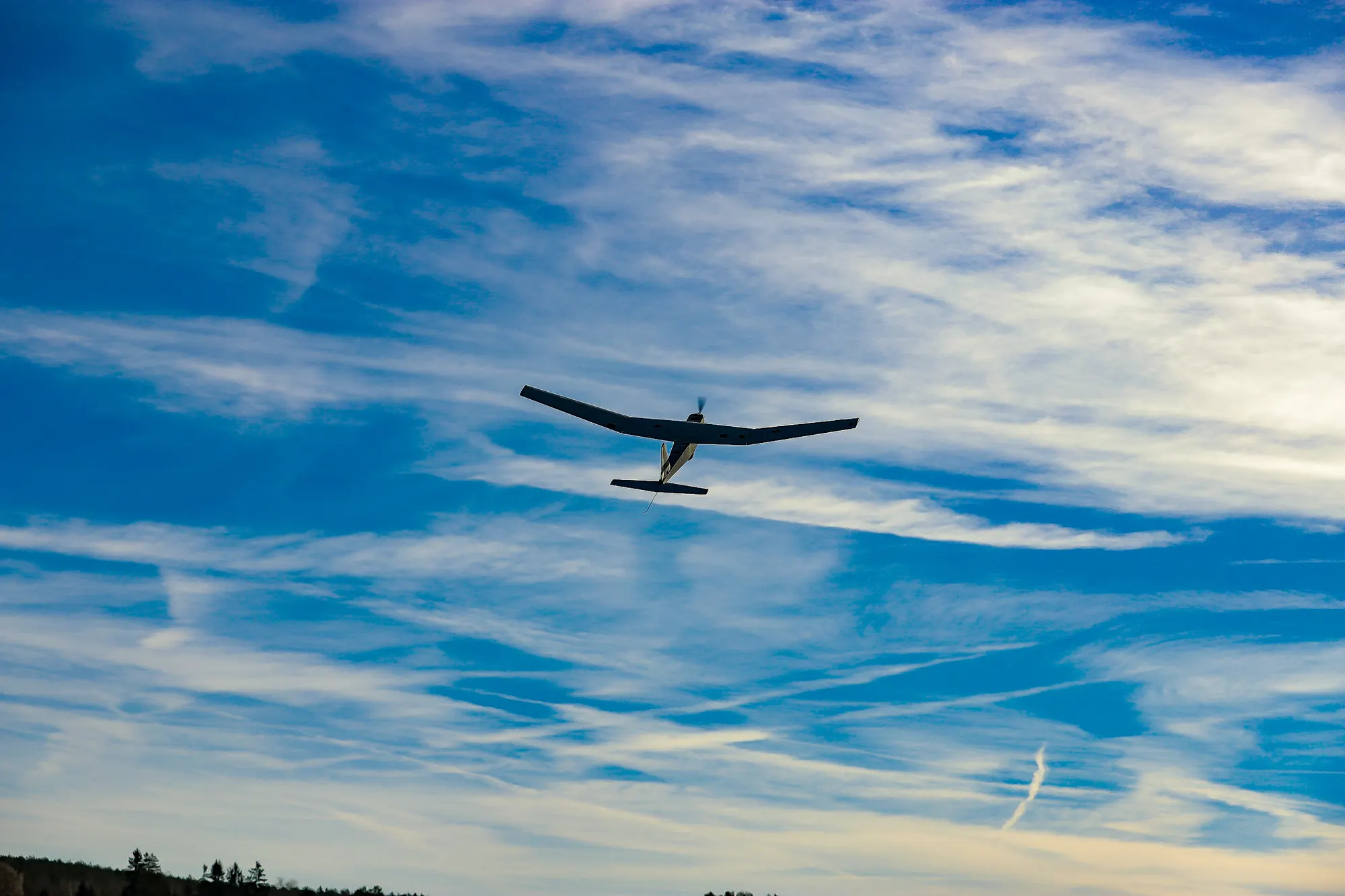
Medium-altitude long-endurance (MALE) aircraft are where Europe has relied most on American and Israeli suppliers, and where its own programmes have moved slowest. The four-nation U950 Eurodrone, led by Airbus for Germany, France, Italy and Spain under OCCAR, is now scheduled to fly for the first time in 2029, Airbus said on 26 June 2026 when it signed a memorandum with Kawasaki Heavy Industries to study a Japanese anti-submarine variant.
In the meantime Tekever has taken the British Army's surveillance programme. The UK Ministry of Defence selected its AR5 to replace the Watchkeeper under Corvus, a contract worth up to £400m over ten years, Tekever announced on 3 August 2026. The aircraft will be built at a new facility in Swindon. Weeks later the Lisbon company closed the first part of a $580m Series D at a $6.4bn valuation, led by UC Investments and Baillie Gifford, The Next Web reported.
Italy has taken a different route. Leonardo and Turkey's Baykar declared their 50:50 joint venture, LBA Systems, fully operational at Farnborough in July 2026, with headquarters in Italy, according to Quwa. Its first product is the Astore Levante for the Italian Air Force, derived from Baykar's TB3 airframe with Leonardo sensors and data links. Baykar itself is Turkish, so it appears here only as context: its designs enter European fleets through the joint venture and through its acquisition of Italy's Piaggio Aerospace.
Loitering munitions
Germany produced the year's biggest loitering munition decisions. On 25 February 2026 the Bundestag budget committee approved initial contracts of about €269m each for Helsing's HX-2 and STARK's Virtus, for the 45th Armoured Brigade stationed in Lithuania, DroneXL reported. Lawmakers cut the combined framework ceiling from €4.3bn to €2bn and capped each company at €1bn.
The Helsing HX-2 is an electric X-wing munition designed to hit artillery and armour up to 100 km away. Ukraine ordered 6,000 in February 2025, and Helsing's first Resilience Factory in southern Germany was set to build 1,000 a month initially, Breaking Defense reported. Helsing's $1.8bn Series E on 13 July 2026 valued it at $18bn, European Security & Defence reported; it is also developing the CA-1 Europa uncrewed combat aircraft.
STARK, founded in 2024, raised €500m in June 2026 led by Sequoia Capital and Founders Fund, at a valuation reportedly above €3.5bn according to Bloomberg, as relayed by The Next Web. Its record is mixed: the Financial Times reported in late 2025 that Virtus missed targets in trials in Germany and Kenya, as summarised by PC-WELT.
Rheinmetall, initially left out, came back. The Bundeswehr signed a framework contract for its FV-014 on 22 April 2026, with a first call-off of about €300m gross and deliveries from the first half of 2027, Rheinmetall said. The company quotes a range of up to 100 km, a 4 kg warhead and up to 70 minutes in the air.
In Poland, WB Group signed three contracts on 28 May 2026 for more than 400 Warmate loitering munitions, nearly 200 FlyEye reconnaissance UAVs and 12 Gladius battery-level units, funded through the EU's SAFE loans, Janes reported. In France, Thales has partnered with Renault Group to industrialise production around its Toutatis, while MBDA is bidding its Akeron RCH 170 in the French medium-range loitering munition tender, Shephard reported in June 2026.
FPV drones and long-range strike
First-person-view (FPV) drones are cheap, short-range and consumed in huge numbers, so the European question is supply chain rather than airframe design. Croatia's Orqa makes its own flight controllers, radios, motors and cameras and says its Croatian plant can produce up to 280,000 NDAA-compliant drones a year. It raised a €12.7m Series A on 10 March 2026 led by Expeditions, Vestbee reported.
At the other extreme, Destinus, headquartered in the Netherlands, builds long-range strike drones and cruise missiles. Its joint venture with Rheinmetall, Rheinmetall Destinus Strike Systems, will start with the compact Kryla (50 kg warhead) and the Ruta Block 2, and is prioritising Ruta Block 3, quoted at more than 2,000 km range, Rheinmetall said on 17 June 2026. Initial delivery readiness is planned for 2026 from a new facility in Germany.
Who is not on the list, and why
Several companies often searched alongside "European drone companies" are not European. Baykar is Turkish; Elbit Systems is Israeli; AeroVironment and Anduril are American. Some of them build or partner in Europe, as Baykar does through LBA Systems, but their design authority and headquarters sit elsewhere. We have also left out pure software companies that fly other firms' aircraft, which belong in the autonomy and AI directory.
By country, Germany has the deepest bench, from Helsing and STARK to Quantum Systems and Rheinmetall (see German defence startups). The UK is adding capacity through Tekever's Swindon plant, France still relies mainly on Thales and MBDA, and Poland is placing some of the largest volume orders on the continent.
What to watch in 2027
Three things will decide which of these drone manufacturers grow into durable suppliers. First, production at scale: the German loitering munition frameworks only pay out in full if deliveries keep pace. Second, the Eurodrone schedule, which a 2029 first flight leaves exposed to faster, cheaper alternatives. Third, the EU's SAFE loans, which already fund Polish drone orders and could tilt more contracts towards European-made systems.
All the startups named here are private companies with no stock ticker; their valuations come from funding rounds, not public markets. This article is for information only and is not investment advice.