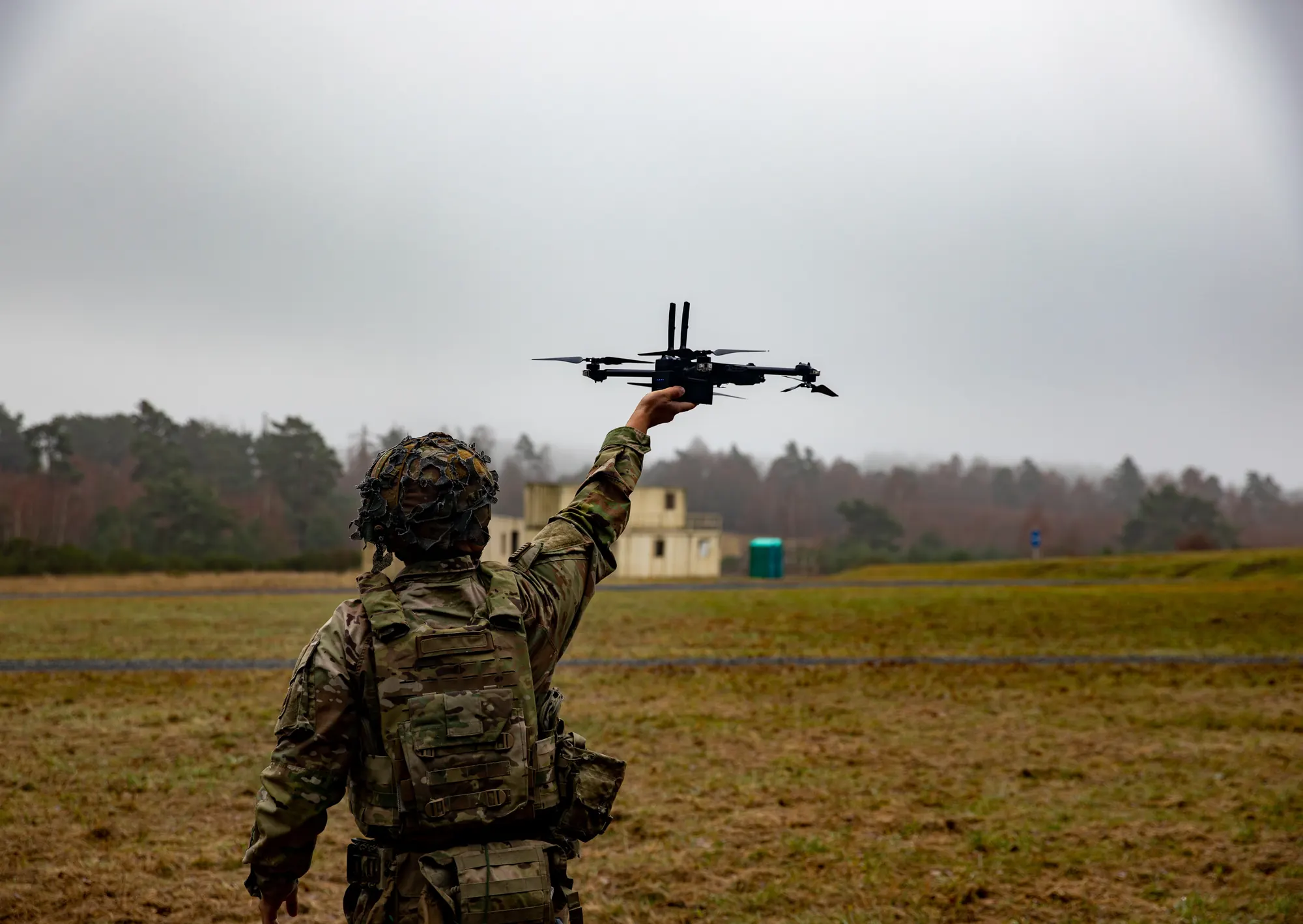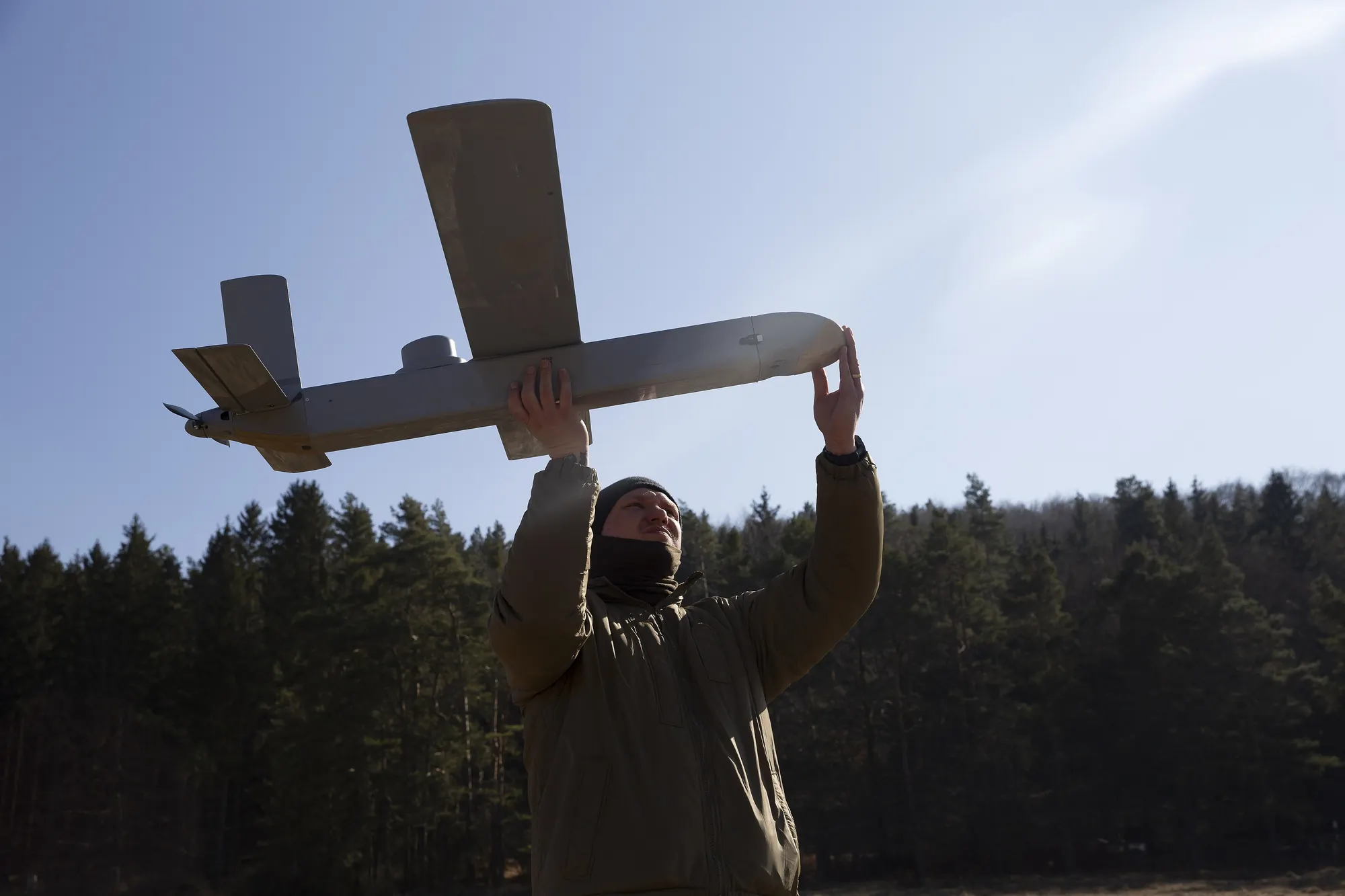
Interceptor drones are small, fast, low-cost uncrewed aircraft that chase an incoming drone and destroy it by ramming, exploding next to it or catching it in a net. In Ukraine they cost about $3,000 to $5,000 each, against more than $3m for a Patriot missile, and by February 2026 they were credited with more than 70% of Shahed drones shot down over Kyiv, Defense News reported on 5 March 2026. European makers include TYTAN Technologies, Alpine Eagle, Alta Ares, Harmattan AI, Origin Robotics and Cambridge Aerospace.
This explainer covers how interceptor drones work, why their economics matter, how Ukraine uses them against Shaheds, and which European companies build them, with the procurement decisions of 2025 and 2026. For the wider counter-drone market (radars, jammers, lasers), see our guide to counter-drone companies in Europe.
How interceptor drones work
An interception has four steps. First, something must detect and cue: radars, acoustic sensors or human spotters find the incoming drone and pass its track to an interceptor crew. In Ukraine, cueing comes from radar tracks, acoustic spotters and the Mission Control battlefield management system, according to Defense News. Second, the interceptor launches and climbs towards the target, often from a site close to the asset it protects.
Third comes guidance. Most Ukrainian interceptors are still flown manually by a pilot wearing first-person-view goggles; "AI features are nice, but sometimes they just aren't working," one unit commander told Defense News. Newer European designs add machine vision for the final seconds of the chase (terminal guidance), and some, such as Origin Robotics' BLAZE, are described as fully autonomous. Fourth is the kill: ramming the target's propellers, detonating a small warhead next to it, or firing a net.
The main types are:
- Quadcopter interceptors, such as Ukraine's Wild Hornets Sting, reported at over 300 km/h with an interception range of about 25 km.
- Fixed-wing and jet-powered interceptors, which trade agility for speed and range, for example Alta Ares' turbojet Black Bird.
- Net and mothership systems, such as Alpine Eagle's Sentinel, where a larger drone carries smaller interceptors, or Germany's net-firing A1-Falke.
- Low-cost missiles, such as Cambridge Aerospace's radar-guided Skyhammer, with a range above 30 km, or Frankenburg Technologies' Mark I, which sit between drones and traditional surface-to-air missiles.
Cost per kill: why interceptors beat missiles against Shaheds
The case for interceptor drones is arithmetic. A Patriot interceptor costs more than $3m and a NASAMS round slightly over $1m, while a Shahed can cost as little as $35,000 to build (a CSIS estimate), which means about an 85-to-1 cost exchange when a Patriot is used against a drone, according to Defense News. Interceptor drones cost $3,000 to $5,000 each with an average success rate above 60%, President Zelensky told Fox News.
On those figures, the cost per Shahed destroyed is roughly $5,000 to $8,300 (our arithmetic: unit cost divided by success rate), well below the cost of the drone being shot down. Ukrainian officials quote even lower prices: interceptors averaging "up to $3,000" against Shaheds costing up to $50,000, a defence ministry adviser said in April 2026, Euromaidan Press reported. These are government and manufacturer figures and have not been independently audited.
Cheapness matters because of volume. Russia launched more than 6,000 missiles and drones at Ukraine in January 2026 alone, per the same report. "No country can produce enough air defence missiles to intercept everything Russia launches," the adviser, Hanna Hvozdiar, said.
Ukraine's interceptor war against Shaheds
Ukraine moved from improvised use to mass production in about a year. Its National Security and Defence Council said 100,000 interceptor drones were produced in 2025, and the defence ministry said about 1,500 a day were reaching the front in December 2025 and January 2026, up from about 1,000, according to Defense News. Interceptors now bring down about one in three Russian aerial targets destroyed over Ukraine, per the Ukrainian air force.
Individual models report large tallies. Skyfall's P1-Sun had shot down more than 3,000 Shahed-type drones in 2026 by late April, and four of the five most effective Ukrainian interceptors (Sting, Merops, P1-Sun and Blyskavka) come from private companies, per Euromaidan Press. Those are official Ukrainian claims.
Russia is adapting. Shaheds now carry rear-facing lights meant to blind interceptor pilots' cameras, some carry air-to-air missiles, and decoys make up roughly a third of mass attacks, Defense News reported. Ukraine is developing faster interceptors for jet-powered Geran-3 variants. The weak link, crews say, is sensing: "We just need better radar," one commander said.
European interceptor drone makers
| Company | Country | System | Type | Status (latest) |
|---|---|---|---|---|
| TYTAN Technologies | Germany | METIS | AI-guided interceptor drone | Ukraine agreements for thousands; €30m Series A (Feb 2026) |
| Alpine Eagle | Germany | Sentinel | Mothership carrying net or kill interceptors | Bundeswehr launch customer (2024) |
| Quantum Systems | Germany | Strila (with WIY Drones) | Interceptor drone | Ukraine tasked delivery of 15,000 (Apr 2026) |
| Argus Interception | Germany | A1-Falke | Net-firing quadcopter | Bundeswehr framework reported above €1.1bn (Oct 2026) |
| Alta Ares | France | X-Lock, Black Bird | AI-guided drone and turbojet interceptors | €50m round (Jun 2026); built in Toulouse and Kyiv |
| Harmattan AI | France | Gobi | Ramming interceptor, about 250 km/h | Deployed by France in the Middle East (reported Apr 2026) |
| Destinus | Netherlands | Hornet | High-speed interceptor, up to 300 km/h | Deployed by France in the Middle East (reported Apr 2026) |
| Origin Robotics | Latvia | BLAZE | Autonomous interceptor with warhead | Delivered to Latvia, Estonia, Belgium (early 2026) |
| Nordic Air Defence | Sweden | Kreuger 100 | Battery-powered kinetic interceptor | $4.4m pre-seed (2025) |
| Cambridge Aerospace | United Kingdom | Skyhammer | Radar-guided interceptor, over 30 km range | UK MoD contracts; $3.4bn valuation (Aug 2026) |
| Frankenburg Technologies | Estonia | Mark I | Low-cost anti-drone missile, up to 2 km | Polish plant with PGZ, up to 10,000 a year (Mar 2026) |
| Greenjets | United Kingdom | Engines and airframes | Propulsion for interceptors | UK LCADE contract (Jul 2026) |
Earlier-stage companies include CDDS in Switzerland and DefSecIntel Solutions in Estonia, which both list interceptor drones, and Portugal's Beyond Vision, which is preparing one. All startup profiles are in our counter-drone directory.
Profiles: who builds what
TYTAN Technologies (Munich) makes METIS for Class I and II threats including Shahed-type drones. Its €30m Series A, co-led by Armira and the NATO Innovation Fund, brought total funding to €46m, and Ukraine has procurement agreements for thousands of METIS interceptors, Munich Startup reported. Alpine Eagle takes the fight into the air: its Sentinel mothership carries interceptors that net or destroy targets, and it plans a 2,000 square metre production site near Munich, The Next Web reported.
Quantum Systems, better known for reconnaissance drones, formed Quantum WIY Industries with Ukraine's WIY Drones in April 2026 to focus on interceptors, after Ukraine tasked it with delivering 15,000 Strila interceptor drones, European Security & Defence reported.
In France, Alta Ares raised €50m led by Air Street Capital in June 2026; X-Lock targets Shahed-type drones out to about 15 km and the turbojet Black Bird reaches 30 km against cruise missiles and glide bombs, The Next Web reported, noting that deployment claims come from the company. Harmattan AI's Gobi rams drones at about 250 km/h (up to 350 km/h) with no explosive, and the Dutch company Destinus makes the Hornet, rated at up to 300 km/h, per Militarnyi, citing the French magazine Challenges.
In the Baltics and Nordics, Origin Robotics began delivering BLAZE to Latvia, Estonia and Belgium in January 2026, EDR Magazine reported, and Nordic Air Defence says its Kreuger 100 is ten times cheaper to produce per unit than conventional anti-drone technology, per Tech.eu. Frankenburg Technologies agreed with Poland's PGZ in March 2026 to build a plant with capacity of up to 10,000 missiles a year, Notes from Poland reported.
Procurement news, 2025 and 2026
- UK and Ukraine, Octopus: under a licence signed in November 2025, the UK began building the Ukrainian-designed Octopus interceptor in January 2026. Ukraine's defence minister said output would reach 1,000 a month from February; the MoD told Janes the UK would supply "thousands" a month, Janes reported on 13 January 2026. The design is updated every six weeks.
- Latvia, BLAZE: Latvia signed its first contract for BLAZE in May 2026 under a December 2025 multi-year framework that other European states can join and that is eligible for EU SAFE loans, Janes reported. Value and quantity were not disclosed.
- UK, LCADE: on 13 July 2026 the MoD awarded £3.16m to Cambridge Aerospace, Greenjets and Frankenburg Technologies to develop low-cost air defence interceptors, the first awards under the five-nation LEAP initiative with Poland, France, Italy and Germany, the MoD said. The aim is to field interceptors by 2027.
- France: France deployed three interceptor drone types (Alta Ares, Harmattan AI's Gobi and Destinus' Hornet) at its Al Dhafra base in Abu Dhabi to counter Iranian Shaheds, Militarnyi reported in April 2026, citing Challenges.
- Germany, A1-Falke: in October 2026 the Bundestag budget committee approved a seven-year framework with Argus Interception for net-firing interceptor drones, reportedly worth more than €1.1bn for up to about 450 systems, with a first order of several dozen worth about €165m and deliveries in 2027, Ekonomický deník reported, citing the German trade site hartpunkt. The Bundeswehr has not published the figures.
At EU level, interceptors fall under the DECODER drone and counter-drone project adopted in September 2026, explained in our guide to the EU drone wall and Eastern Flank Watch.
Limits and open questions
Interceptor drones are not a complete air defence. They depend on radar and other sensors to find targets, struggle in bad weather, and are slower than jet-powered drones and cruise missiles, which is why companies are building faster turbojet and rocket-powered designs. Manual piloting limits how many interceptions one crew can handle in a mass raid, and autonomy is still unproven at scale. For investors and buyers, the open question is whether European factories can match Ukraine's volumes: TYTAN, Origin Robotics and Frankenburg all talk in thousands, while Ukraine produced 100,000 in 2025.
Most companies named here are private and have no stock ticker. This article is for information only and is not investment advice.