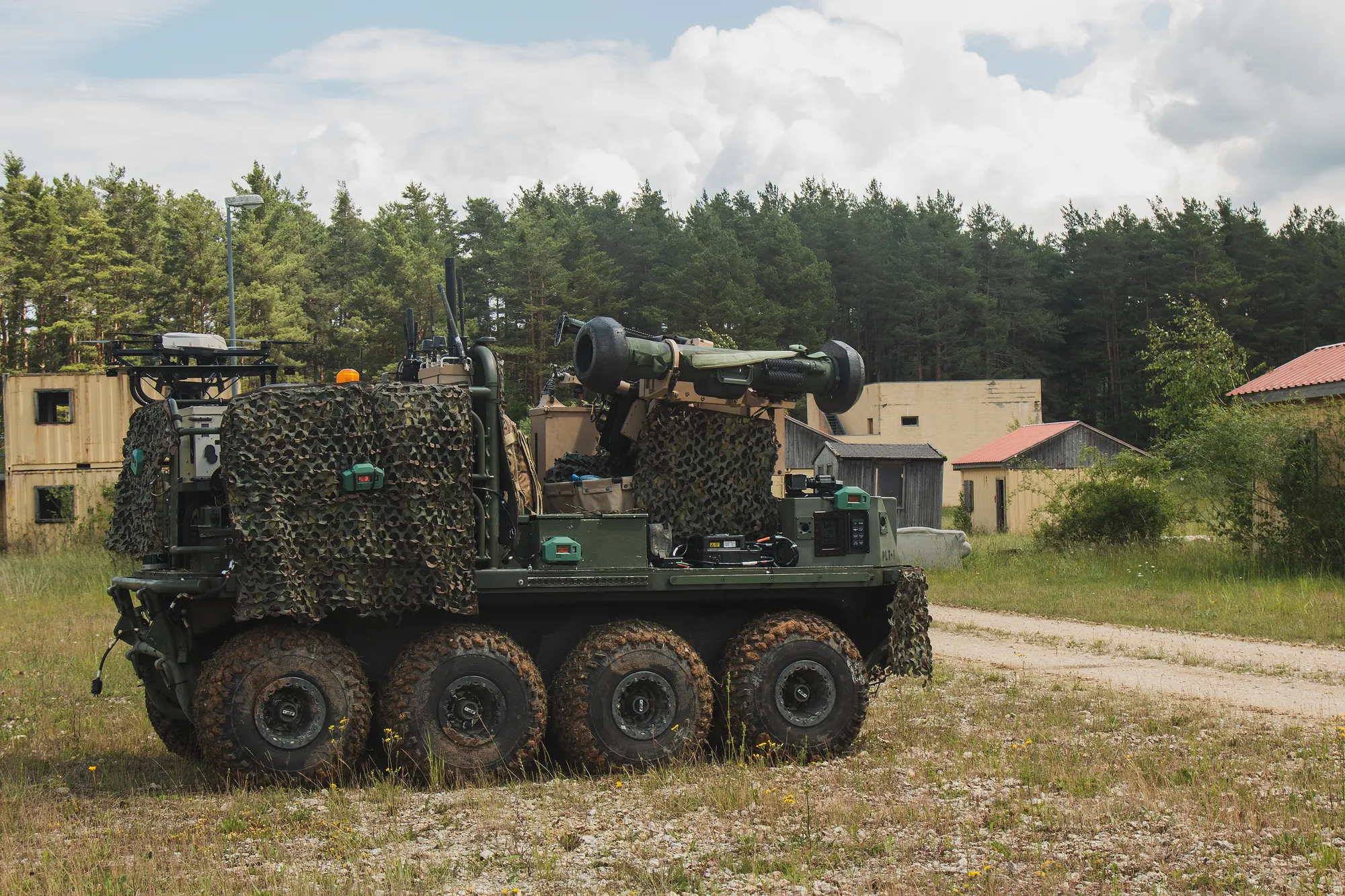
Ukrainian ground robots, or unmanned ground vehicles (UGVs), are remotely operated tracked and wheeled vehicles that haul ammunition, evacuate the wounded, lay and clear mines and carry weapons where crewed vehicles can no longer drive safely. In October 2026 they completed a record 31,398 missions, more than four times the 7,511 recorded in January, the Defence Ministry said on 6 November. The main makers include Tencore (TerMIT), Ratel Robotics, Roboneers, DevDroid, Temerland, Rovertech, Frontline Robotics and SkyLab UA.
Below: why the robots took off, the numbers, the companies, the European co-production deals, the limits and demining. For the wider picture, see our overview of Ukraine's defence tech startups, the companies on our Ukraine country page and every European maker on the ground robotics sector page.
Why Ukraine turned to ground robots
The cause is the drone-saturated strip along the front. Because Russian first-person-view (FPV) drones fill the air, this "kill zone" has effectively barred ordinary vehicles from logistics runs, rotations and casualty evacuation, the Kyiv Independent reported. A destroyed robot costs equipment and operator time; a destroyed truck can cost its crew.
The ministry wants to move all frontline logistics off soldiers and onto robots, Defense News reported in April 2026. The robots do five jobs:
- Logistics: ammunition, water, food and fuel to positions, the most common task.
- Casualty evacuation: stretcher or basket modules that bring wounded soldiers out of positions vehicles cannot reach.
- Mining and demining: remote mine-laying, and flails or line charges that open lanes through minefields.
- Combat: remote weapon stations with machine guns or grenade launchers, or the robot itself as an explosive charge.
- Carrying and launching drones, plus electronic warfare payloads.
The case is simple arithmetic in manpower. A Roboneers co-founder told The Irish Times in November 2025 that one robot had carried 200 kg of supplies 10 km to a position, a run the commander said would otherwise have taken 18 men.
The numbers: missions, contracts and the 50,000 target
Usage has grown almost every month of 2026. Units ran more than 171,000 UGV missions in the first ten months of the year, according to a Defence Ministry explainer published on 11 November, with October the highest month since the ePoints programme began counting.
Procurement has grown with it. The Defence Procurement Agency had contracted more than 22,000 UGVs for 2026 by 20 July, nearly double the total for all of 2025, the ministry's ZBROYA portal said. Of those, 2,069 were chosen by combat units through the DOT-Chain Defence marketplace, and 67 new UGV models had been codified for operational use since January. By 27 October the UGV section of Brave1 Market listed more than 280 products in eight subcategories (see our Brave1 explainer).
The political target is higher. On 27 April President Zelensky gave the defence minister and the General Staff the task of fielding "at least 50,000 UGVs" in 2026, Ukrainska Pravda reported. The latest contracted figure the ministry has published, more than 22,000, is less than half of that goal; we found no updated full-year count as of 14 November.
The money and the industry behind these figures:
- Spending: the MoD Procurement Agency spent UAH 11 billion (about $247 million) on UGVs from 1 January to 18 April 2026, according to figures cited by The Robot Report.
- Growth: UGV production rose 488% in 2025, the Kyiv School of Economics estimated, and the segment was worth $252 million that year, Euromaidan Press reported.
- Makers: Brave1 counted around 300 ground-drone companies in February 2026, up from none in 2022, and had issued 175 grants to them, its chief executive told Military Times (via Defense News).
These are government and company figures and have not been independently audited.
Ukraine's UGV makers in 2026
The makers in our directory, with their latest public round or deal as of 14 November 2026:
| Company | Flagship UGVs | Main roles | Latest round or deal |
|---|---|---|---|
| Tencore | TerMIT (tracked, modular) | Logistics, evacuation, engineering, weapon stations | Quantum Tencore Industries order for 2,000 TerMIT (Jun 2026); $3.74m from MITS Capital (Jul 2025) |
| Ratel Robotics | Ratel H, Ratel M | Logistics, evacuation, reconnaissance, demining, strike, drone launch | Acquisition by Swarmer for up to $224m, pending (signed Sep 2026) |
| Roboneers | Rys+, Rys Pro; ShaBlya weapon station | Logistics, evacuation, fire support | ARX Industries joint venture with ARX Robotics (Jun 2026) |
| DevDroid | Droid TW 7.62, Droid TW 12.7, Droid NW 40; Droid Box control system | Combat, remote weapon stations | Droid Box codified (Apr 2026); memorandum with Italy's ABET HTS, joint venture in preparation (Oct 2026) |
| Temerland | Gnom Logistic, Gnom L2 | Logistics, fire support, mine-laying | Gnom L2 unveiled (Aug 2026); no disclosed round |
| Rovertech | Zmiy, Zmiy-500 | Demining, logistics | No disclosed round |
| Frontline Robotics | Frodo (6x6) | Logistics, evacuation, fire support | Frodo unveiled, codified per the company (Sep 2026) |
| SkyLab UA | Sirko-S1 with TROPIYA module | Cargo, evacuation, reconnaissance, demining | TROPIYA demining module presented (Dec 2025); no disclosed round |
Tencore
Tencore says it has delivered more than 4,000 robotic platforms to the armed forces across more than 50 brigades and cites capacity of over 500 units a month, Kyiv Post reported on 12 October 2026; these are company figures. Its TerMIT is a tracked, modular platform for logistics, medical evacuation, engineering work and weapon stations. In July 2025 it raised $3.74m from MITS Capital at a $50m valuation, described by dev.ua as the largest publicly confirmed round in Ukraine's ground robot sector at the time.
Roboneers and DevDroid
Roboneers' Rys+ was codified in July 2026 with a 350 kg payload, an operational range of up to 80 km and room to evacuate two people at once, according to the company via Ukrainska Pravda. DevDroid builds armed robots and also sells its control system: the Droid Box, codified in April 2026, runs six communication channels including digital radio, LTE and Starlink, counters GNSS spoofing and is fitted to more than 1,000 robots across eight platforms, the company told Militarnyi. Its Droid TW 7.62 and TW 12.7 trained with the Italian Army alongside ABET HTS robots and were linked to a NATO situational-awareness system, and the two companies are preparing a joint venture, United24 reported on 1 October.
Temerland and Frontline Robotics
Temerland's Gnom Logistic is in service, and its Gnom L2 variant, unveiled in August 2026, carries 210 kg on a hybrid wheel and track system, The Defense Post reported. Frontline Robotics, better known for drones, unveiled the Frodo 6x6 in September with a 400 kg maximum payload and a 150 km range, according to Janes.
Ratel Robotics and Swarmer: the first listed buyer
On 10 September 2026 Nasdaq-listed Swarmer (SWMR) agreed to buy Ratel Robotics for cash and stock worth up to $224m if all earnout milestones are met. Ratel had signed $86m of contracts in 2026 and accounted for about 37% of the UAH 11 billion spent by the MoD Procurement Agency on UGVs between 1 January and 18 April, The Robot Report reported, citing the companies.
Most of the headline price is conditional. Swarmer's proxy filing sets the closing payment at about $7.2m in cash, adjusted for cash, debt and working capital, plus 1,064,942 shares; a further $7.2m in cash and up to 4,422,125 shares depend on revenue and operating income targets for 2026 to 2028. Swarmer stockholders approved the share issuance on 2 November, an SEC filing shows.
On 11 November Swarmer said Ratel's preliminary unaudited revenue was $42.1m for the first nine months of 2026, with a backlog of about $65.1m at 30 September, and that it expected the deal to close in November subject to the remaining conditions. As of 14 November no closing had been announced, so the acquisition is still pending.
European co-production: TerMIT and Rys abroad
Ukrainian UGV designs are now co-built with foreign partners under the Build with Ukraine model, which our article on Build with Ukraine joint ventures covers in full. The ground robot deals so far:
| Deal | Partners | Where | Status and scope |
|---|---|---|---|
| Quantum Tencore Industries | Quantum Systems, Tencore | Germany | Joint venture selected in Jun 2026 to deliver 2,000 TerMIT to Ukraine over 12 months, funded by the German MoD |
| ARX Industries | ARX Robotics, Roboneers | Germany and Ukraine | Joint venture formed 25 Jun 2026; thousands of Rys Pro in year one, aiming for tens of thousands a year later |
| Tencore and Insta | Tencore, Insta | Finland | Joint venture signed 23 Aug 2026; TerMIT 2.0, initial target of 320 systems |
| Tencore and Shark Robotics | Tencore, Shark Robotics | Not disclosed | Memorandum signed Apr 2026 to set up two joint ventures, combining combat and civil protection robotics |
| Tencore and Dominion Dynamics | Tencore, Dominion Dynamics | Canada | Memorandum of understanding (Oct 2026); production planned from 2027 for Ukraine and NATO partners |
The German order is the largest. Quantum Tencore Industries, the second Ukrainian joint venture of Quantum Systems, will build the TerMIT in Germany with an industrial partner, and the companies described the 2,000-unit initial order as the largest UGV procurement to date, European Security & Defence reported on 19 June. In Finland, Tencore and Insta will produce TerMIT 2.0 for Ukraine's forces, Militarnyi reported. The Canadian plan is a technology transfer, according to United24.
The Rys Pro deal with ARX Robotics was reported by Tech.eu; France's Shark Robotics builds firefighting, logistics and demining robots. For other German players, see our list of German defence tech startups.
What units report: electronic warfare, terrain, attrition and cost
Mines, FPV drones, small-arms fire, broken links and hard terrain destroy the robots often, and platforms that do well on test ranges frequently meet their hardest ground for the first time in combat, Lesia Bidochko wrote in War on the Rocks in September 2026. In a late-2025 interview, Tencore's chief executive Maksym Vasylchenko said one brigade working with the company had reported losing two to five robots a day.
The main limits reported so far:
- Range and links. Many early robots were designed for control ranges of 2 to 5 km, while supply and evacuation routes now run 15 to 20 km through the kill zone. Units switch between radio, Starlink, fibre-optic cable and aerial relays, and a broken video link can strand a robot in a crater.
- Electronic warfare. Since mid-2026 Russia has fielded jammers aimed at the satellite frequencies Starlink terminals use, and Starlink uplink capacity is often too small for continuous video even without jamming, according to the same analysis. Makers answer with multi-channel kits such as DevDroid's Droid Box.
- Armour versus mobility. More armour adds weight, heat and cost; lighter robots give up protection. Ukraine has largely accepted higher attrition in exchange for mobility and fast replacement.
- Operators. One industry chief executive quoted by War on the Rocks estimated that no more than 1% of systems used in combat are truly autonomous, so each robot still needs a person at the controls.
- Cash. Swarmer's proxy says Ratel's government contracts generally require advance payments and impose penalties for late delivery, which ties production to working capital.
The demining angle
Robots also matter for Ukraine's longest post-war job. About 133,300 square kilometres, potentially 21.5% of Ukraine, needs survey and possible clearance, according to the State Emergency Service as cited by UNDP in July 2026, down from an initial estimate of 174,000 square kilometres. A Globsec report estimated that clearance could take over 700 years with current resources, the Kyiv Independent reported in a UNDP-sponsored article in December 2024.
Four companies in our directory work on the problem from different ends:
- Rovertech built the Zmiy, a blast-resistant flail robot described as the first remote demining vehicle developed and certified in Ukraine, at an estimated $20,000 against up to EUR 1m for typical demining machines; it was making up to 40 a month in December 2024, its co-founder told the Kyiv Independent.
- SkyLab UA fits its Sirko-S1 with the TROPIYA module, which fires a rocket that pulls a demining charge 100 to 150 metres across a minefield before it detonates, Ukrainska Pravda reported in December 2025.
- UADamage fuses drone and sensor data with AI to map mines and unexploded ordnance, has supported more than 40 demining and land assessment missions and raised an undisclosed round from Ondas Capital and Pravo Ventures in November 2026, dev.ua reported.
- Dropla Tech, a Danish-Ukrainian company, makes the Blue Eyes Warbox edge-AI system for detecting mines, IEDs and drones (with a NATO Stock Number) and 4x4 and 6x6 UGVs; MITS Capital invested in July 2026, The Defense Post reported.
What to watch
Three things will show whether the sector keeps its pace into 2027: whether Ukraine's contracted volume closes the gap to the 50,000 target, whether the German and Finnish TerMIT lines deliver on schedule, and whether the Swarmer and Ratel deal closes and gives other UGV makers a route to Western capital. For the aerial side of the same industry, see our guide to Ukrainian drone manufacturers and our list of European military drone manufacturers.
This article is for information only and is not investment advice. Swarmer is listed on Nasdaq under the ticker SWMR; Ratel Robotics, Tencore, Roboneers and the other Ukrainian makers named here are private companies and have no stock ticker.