Ukraine's defence tech ecosystem counts about 2,500 companies and more than 5,000 defence solutions registered with Brave1, the state defence tech cluster, according to the Ministry of Defence on 6 November 2026. The number of drone makers has grown from 7 in 2022 to more than 500, and Brave1-supported teams have raised more than $450 million in disclosed venture money. Six days later, London-headquartered, Ukrainian-founded UFORCE announced a $700 million Series A at a $6 billion valuation, fourteen times the $50 million round the ministry had just listed as the sector's largest.
This overview covers the size of the ecosystem, where the money is coming from, the leading companies by sector, exports and joint ventures, how investors get in, and the risks. For the full list of verified profiles, see our Ukraine country page; for the drone makers in detail, see Ukrainian drone manufacturers.
How big is Ukraine's defence tech ecosystem in 2026?
The best single measure is Brave1, launched by the government in 2023 to fund, test and connect defence startups. Its grant programme has grown every year, and the 2026 total passed the full 2025 figure before November.
| Year | Brave1 grants | Value |
|---|---|---|
| 2024 | 289 | $19.7m |
| 2025 | 325 | $60.9m |
| 2026 (to 2 Nov) | 353 | $67.3m |
Source: Ministry of Defence of Ukraine, 6 November 2026. Hryvnia sums converted at the National Bank of Ukraine rate of 28 October 2026.
The demand side runs through Brave1 Market, an online marketplace where military units order directly from manufacturers. As of November 2026 the ministry lists 7,087 solutions from 955 companies on it, with more than 903,000 items ordered worth $1.39 billion and more than 774,000 items worth $1.15 billion delivered, to 486 units. Units can pay with e-points earned for verified battlefield results, which ties orders to combat performance.
Drones dominate. Troops ordered more than 590,000 drones through the marketplace in the first nine months of 2026, the ministry said on 25 September, with interceptor drones the most ordered category, ahead of FPV strike copters. Bomber drones took the largest share of spending. For how interceptors work and who builds them in Europe, see our interceptor drones explainer.
Total output is far larger than the marketplace. Ukraine produced roughly 4 million drones in 2025, Euromaidan Press reported in July 2026, and Deputy Defence Minister Serhii Boiev said in January that the country plans to produce more than 7 million in 2026 (Militarnyi). The 7 million figure is a plan, not a count. The Ministry of Defence gives a higher number: its Brave1 explainer (6 November 2026) says Ukraine "already produces around 10 million drones a year" and that the next target is 20 million. The ministry does not say how it counts (annual capacity or actual output, finished drones or kits), so the two sets of figures are not directly comparable.
The money: from $105 million in 2025 to a $700 million round
Private investment started small. More than 50 Ukrainian defence tech startups raised over $105 million in venture and angel money in 2025, according to preliminary Brave1 data reported by the Kyiv Post on 8 December 2025. Most rounds were $200,000 to $400,000. The largest disclosed was Swarmer's $15 million, though Brave1's head of investment attraction, Artem Moroz, said several undisclosed rounds were larger.
In 2026 the cheque sizes changed. The main deals:
| Company | Deal | Date | Status |
|---|---|---|---|
| UFORCE | $50m at a valuation above $1bn | Mar 2026 | Closed |
| UFORCE | $700m Series A at a $6bn valuation | 12 Nov 2026 | Announced |
| Swarmer | Nasdaq IPO, $15m at $5 a share | 16 Mar 2026 | Listed (SWMR) |
| Ratel Robotics | Acquisition by Swarmer, up to $224m | 9 Sep 2026 | Expected to close Nov 2026 |
| Airlogix | About $100m at a valuation above $2bn | Oct 2026 | Reportedly in talks (Forbes) |
| Buntar Aerospace | $10.4m, then $16m | Mar and Oct 2026 | Closed |
| Vyriy Industries | UAH 1bn in bonds from 24,000+ retail investors | Aug to Sep 2026 | Sales open to 31 Dec 2026 |
| Sine Engineering | First investment of the US-Ukraine Reconstruction Investment Fund | Mar 2026 | Amount undisclosed |
| HIMERA | More than $2.5m led by Green Flag Ventures | Dec 2025 | Closed |
| Tencore | $3.74m from MITS Capital at a $50m valuation | Jul 2025 | Closed |
UFORCE brought together nine Ukrainian companies under a London holding and raised $50 million at a valuation above $1 billion in March, Dealroom reported. On 12 November it announced a $700 million Series A at $6 billion, co-led by Valor Equity Partners and the UK National Wealth Fund, with the US-Ukraine Reconstruction Investment Fund among the new investors. Its products include MAGURA naval drones, NEMESIS strike drones and LIUT ground robots. Chief executive Oleg Rogynskyy told CNBC that bookings more than doubled over the past year from "several hundred million dollars", without giving exact figures. The ministry's 6 November explainer still named UFORCE's $50 million as the largest round, which shows how fast the figures are moving.
Swarmer, an Austin-based autonomy software company with Ukrainian roots, priced a small Nasdaq IPO on 16 March 2026 and closed its first day at $31, up 520%, IPOScoop reported. In September it agreed to buy UGV maker Ratel Robotics for up to $224 million in cash and stock, much of it tied to earnouts (The Robot Report). Shareholders approved the share issuance on 2 November, and in its third-quarter results filed on 10 November Swarmer said it expects closing in November. The same filing gives Ratel preliminary, unaudited revenue of $42.1 million for the first nine months of 2026 and about $65.1 million of backlog.
Airlogix is reportedly in talks to raise about $100 million at a valuation above $2 billion, Forbes reported on 9 October, citing two unnamed sources (via DroneXL). The company declined to comment. Vyriy Industries took a different route: it raised UAH 1 billion from more than 24,000 retail investors in 20 days through the Inzhur MilTech fund, whose certificates convert into bonds yielding 25% to 29% a year, LB.ua reported on 2 September. The target is UAH 2 billion. Buntar Aerospace raised $10.4 million in March with Axon among the investors, then $16 million in October led by Freedom Fund VC, taking its total to $30 million.
Leading Ukrainian defence tech companies by sector
The table lists a selection of the companies in our directory, verified on 14 November 2026. "Not disclosed" means no public round was found; many of these firms are funded by state contracts rather than venture capital.
| Company | Sector | What they make | Latest round |
|---|---|---|---|
| Airlogix | Drones | GOR reconnaissance drone, Anubis and Seth-X strike drones | Reportedly in talks, about $100m (Oct 2026) |
| Vyriy Industries | Drones | Vyriy 10 and 15 FPV strike drones | Bonds, UAH 1bn (Sep 2026) |
| General Chereshnya | Drones | FPV strike drones, including fibre-optic, and interceptors | Not disclosed |
| SkyFall | Drones | Vampire bomber, Shrike FPV, P1-SUN interceptors | Not disclosed |
| Buntar Aerospace | Drones | Buntar-3 VTOL reconnaissance drone, Copilot software | $16m (Oct 2026) |
| Skyeton | Drones | Raybird long-range reconnaissance drone | Not disclosed |
| Fire Point | Long-range strike | FP-1 strike drone, FP-5 Flamingo cruise missile | Not disclosed |
| UFORCE | Maritime and multi-domain | MAGURA naval drones, strike drones, ground robots | $700m Series A (Nov 2026) |
| Ratel Robotics | Ground robotics | Ratel H and M modular ground robots | Acquisition by Swarmer, up to $224m (Sep 2026) |
| Tencore | Ground robotics | TerMIT modular UGV | $3.74m (Jul 2025) |
| Roboneers | Ground robotics | Rys UGVs, ShaBlya remote weapon station | Not disclosed |
| Wild Hornets | Counter-drone | Sting interceptor drone | Not disclosed |
| Zvook | Counter-drone | Passive acoustic sensor network | Not disclosed |
| Sine Engineering | Electronic warfare and links | Jamming-resistant datalinks, GPS-free navigation | URIF strategic investment (Mar 2026) |
| HIMERA | Electronic warfare and comms | G1 PRO secure tactical radio | More than $2.5m (Dec 2025) |
| Unwave | Electronic warfare | Vikha directional jammer, Pastka EW software | Not disclosed |
| The Fourth Law | Autonomy and AI | TFL-1 terminal guidance module for FPV drones | Strategic, undisclosed (Feb 2026) |
| L7 Simulators | Training | UNITS military training simulators | Not disclosed |
Drones are the core, from mass-produced FPVs to long-range strike aircraft; browse the drones sector page or our European military drone manufacturers list for comparison. Fire Point sits apart as a deep-strike producer of drones and cruise missiles (loitering munitions).
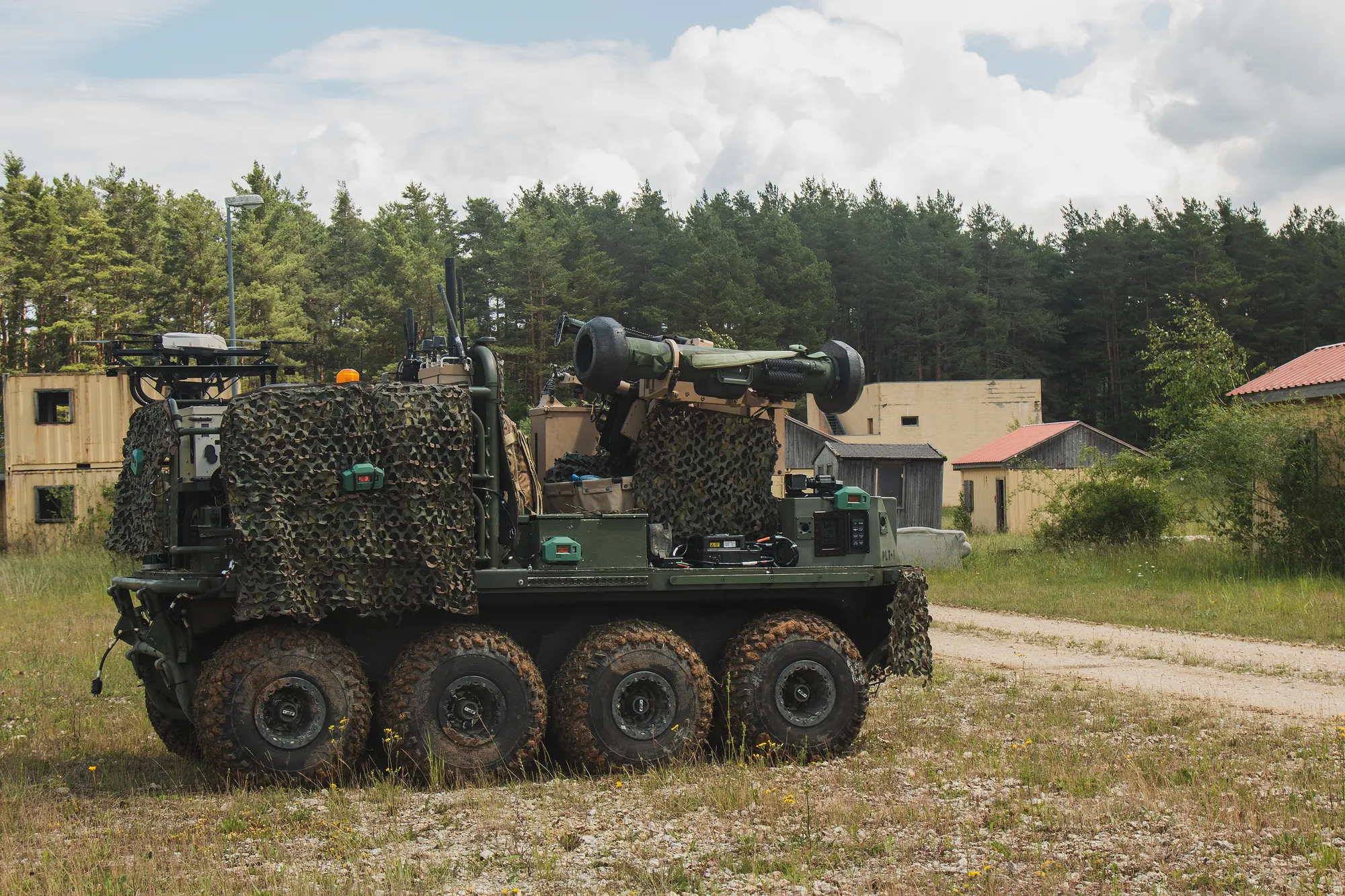
Ground robots are the fastest-growing segment. The Kyiv School of Economics estimated that UGV production rose 488% in 2025 and put the segment at $252 million (Euromaidan Press, April 2026). The ministry's procurement agency spent UAH 11 billion, about $247 million, on UGVs from 1 January to 18 April 2026, with Ratel taking about 37%, according to The Robot Report. See the ground robotics sector and our guide to Ukrainian ground robots.
Electronic warfare, communications and counter-drone firms such as Kvertus, Unwave and Sine Engineering supply the jammers, datalinks and sensors that every drone fight depends on; Sine says more than 150 Ukrainian drone makers use its technology. HIMERA launched its OBRIA NANO test satellite for a sovereign Ukrainian communications network on 1 October 2026 with Denmark's GomSpace (SatNews). See the electronic warfare, counter-drone and autonomy and AI sector pages.
Exports and joint ventures
On 1 July 2026 the Cabinet launched a controlled export mechanism for partners under the Drone Deal framework, valid for the period of martial law. Contracts for finished products must be worth at least UAH 15 million, and 20% of proceeds (30% for components) goes to a state fund for the defence industry. Permits can be refused if the ministry plans to buy the same product or if it is on a quarterly updated list of critical goods.
The bigger channel so far is production abroad. The Auterion and Airlogix joint venture began serial production of Seth-X and Anubis strike drones in Germany on 21 September 2026 against an order of more than 5,000 systems, and Quantum Tencore Industries was selected to deliver 2,000 TerMIT UGVs over 12 months funded by the German Ministry of Defence (ESD, June 2026). Tencore also has a joint venture with Finland's Insta and a memorandum to set up joint ventures with France's Shark Robotics, and Roboneers formed ARX Industries with Germany's ARX Robotics. The full map of these deals, including the Danish financing model, is in our Build with Ukraine joint ventures guide.
How investors get in
There are six main routes, and most Ukrainian defence companies are private, with no ticker.
- Venture rounds. Specialist funds active in 2025 and 2026 include Green Flag Ventures (HIMERA), MITS Capital (Tencore), Freedom Fund VC, Iron Wolf Capital and Autonomy Capital (Buntar). Brave1 runs investor demo days and a data room; see our Brave1 explainer.
- Strategic stakes. Corporates buy in alongside production deals. Quantum Systems took a 10% stake in Frontline Robotics with an option to reach 25% (Quantum Systems, July 2025), and Axon has backed Buntar and The Fourth Law.
- Joint ventures. Western manufacturers co-own production lines outside Ukraine, as above.
- Public equity. Swarmer (Nasdaq: SWMR) is the only Ukrainian-rooted defence tech company in this overview with listed shares.
- Retail bonds. Vyriy's issue is open to Ukrainian retail buyers from UAH 1,000 through the Inzhur platform.
- State-backed funds. The US-Ukraine Reconstruction Investment Fund, co-managed by the US DFC and Ukraine's Ministry of Economy, made Sine Engineering its first investment in March 2026 after more than 200 applications (Defence Network) and joined UFORCE's Series A.
Risks: strikes, export permits and governance probes
Physical risk. Producers are targets. On 22 June 2026 a Russian attack damaged a production facility of General Chereshnya, one of the largest FPV makers; the company said no employees were hurt (Kyiv Independent). Firms respond by dispersing work. Airlogix chief executive Vitalii Kolesnichenko said in October that "we basically were forced to break down our manufacturing cycles" into many small pieces (DroneXL).
Export risk. Domestic needs come first, and permits are discretionary. Ukrspecsystems opened a UK plant in February 2026, but by the end of July it had not started production because its export permit applications were refused on the grounds that the products serve the Armed Forces, the company told Militarnyi. The 20% to 30% export levy also cuts margins on any foreign sale.
Governance risk. Rapid procurement growth has drawn investigators. The National Anti-Corruption Bureau (NABU) has been examining possible overpricing in drone supply contracts involving Fire Point, the Kyiv Independent reported in August 2025. Fire Point confirmed the probe, denied wrongdoing and called the claims rumours. NABU said in December 2025 that no one had been notified of suspicion (LIGA.net), and no charges have been reported. Separately, on 7 July 2026 the State Bureau of Investigation searched premises linked to Vyriy's chief executive in a case about alleged inflation of drone costs; a court later refused a request to seize UAH 32 million, finding the funds were not linked to the case, and the company says it is cooperating (LB.ua). No charges against the company have been reported.
Valuation and disclosure risk. Most numbers come from companies or unnamed sources. Ratel's revenue figures in Swarmer's filing are unaudited and prepared by Ratel's management, and Swarmer itself reported third-quarter revenue of $25,554 and a net loss of about $9.3 million. Private valuations such as UFORCE's $6 billion or the reported Airlogix talks are not market prices.
This article is for information only and is not investment advice.